Common Knitting Mistakes Beginners Make and How to Fix Them
Extra stitches, holes, twisted stitches and tight edges all have simple causes. Learn how to recognize the most common beginner knitting mistakes and put each one right.

Your first swatches will probably have a hole or two, an edge that wanders and a stitch count that refuses to stay put. That is normal. The most common knitting mistakes are the same handful every beginner makes, and each one has a clear cause and a simple fix.
Learn to recognize them and you can catch a problem within a row or two, when putting it right takes seconds.
Quick diagnosis
| What you see | Likely cause | What to do |
|---|---|---|
| The piece is getting wider | Accidental extra stitches | Count, find the extra, undo back to it |
| A hole with a ladder below it | Dropped stitch | Secure the loop and hook it back up |
| A stitch that looks crossed at the base | Twisted stitch | Knit it through the back loop |
| A bottom edge that pulls in | Tight cast-on | Cast on more loosely next time |
| A ridge across smooth fabric | Knit row where a purl row belonged | Undo back to that row |
Extra stitches that appear from nowhere
You cast on 20 stitches and now have 24. Three habits cause nearly all of this.
- The first-stitch trap. At the start of a row, if the working yarn is pulled up and over the top of the needle to the back, it drags the first stitch around so that both of its legs sit on the needle and look like two loops. Knit both and you have added a stitch. Let the yarn hang straight down, then take it to the back under the needle tip.
- Accidental yarn overs. A yarn over (yo) is a wrap of yarn across the needle. It adds a stitch and leaves a small hole. When you switch between knit and purl, move the yarn between the needle tips, never over the needle. This matters most when you knit ribbing.
- Knitting into the strand between stitches. The horizontal strand between two stitches can look like a loop when the stitches are spread out. Work only the loops that sit on the needle.

Tip
Count your stitches every few rows. It takes a few seconds and tells you about a problem while it is still only a row or two deep.
Stitches that go missing
A falling stitch count has two usual causes. The first is a dropped stitch: a loop slipped off the needle and has run down, leaving a ladder. Put a locking marker through the loop right away, then fix the dropped stitch with a crochet hook.
The second is working two stitches together by accident, which happens when stitches are crowded at the needle tip. There is no ladder, only one thick stitch with two loops at its base. Undo back to it and work the two loops separately.
Twisted stitches
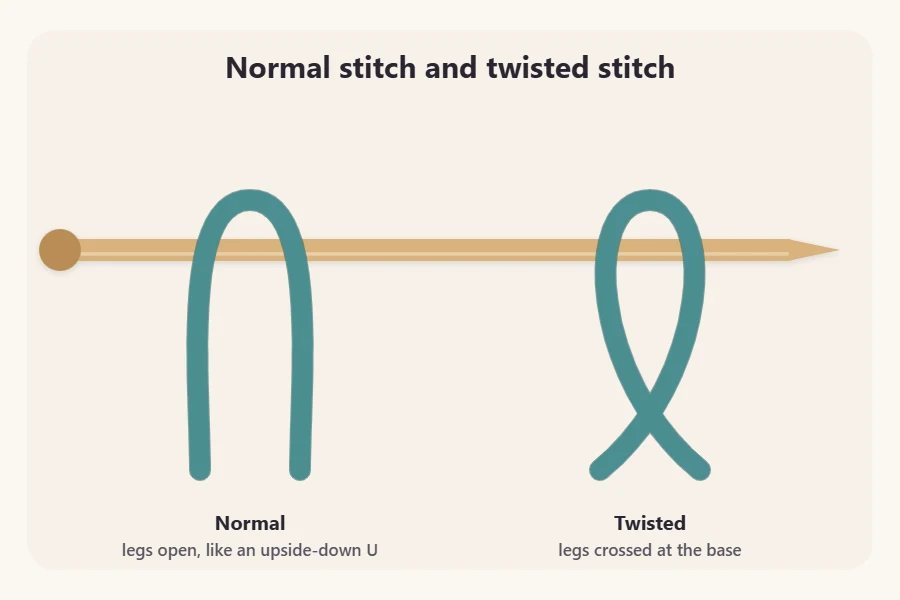
A stitch sitting correctly on the needle has its leading leg, the one nearer the needle tip, in front of the needle. On a twisted stitch that leg sits behind the needle, and when you knit it normally, the stitch crosses at the base and feels tight.
Stitches usually get twisted in one of two ways: the yarn was wrapped clockwise, not counterclockwise, on the row before, or stitches were put back on the needle the wrong way around after you ripped out some rows.
The fix is quick. Knit the stitch through the back loop, which untwists it, or lift it off, turn it around and put it back.
Knitting in the wrong direction after a break
If you put your knitting down in the middle of a row, it is easy to pick it up facing the wrong way and knit back over the stitches you just made. The result is a short extra section of rows and a small hole where you turned.
The check is simple. The working yarn always comes from the last stitch you made, and that stitch belongs on the right needle. If the yarn is hanging from the left needle, turn the work around. Finishing the row before you stop avoids the question altogether.
Edges and stitches that are too tight
Tight knitting is the classic beginner habit. If you have to force the needle into every stitch, you are probably forming stitches on the narrow needle tip and tugging the yarn after each one.
- Push each new stitch onto the full width of the right needle before you move on.
- Let the needle set the stitch size. Do not pull the yarn snug after every stitch.
- Cast on loosely enough that the stitches slide along the needle. A cast-on that is too tight makes a bottom edge that pulls in.
- Bind off loosely. A needle one or two sizes larger in your right hand helps.
How you hold the yarn matters most here, so read about knitting tension early on.
Uneven stitches
Stitches of mixed sizes are less a mistake than a stage. Your hands are still learning how much yarn to feed for each stitch, and that settles with practice. Washing the finished piece and laying it flat to dry also evens out a good deal.
A ridge where the fabric should be smooth
In stockinette stitch you knit the right side (RS) rows and purl the wrong side (WS) rows. Knit two rows in a row by accident and a ridge of bumps appears across the smooth face.
You do not need to remember which row you are on. Look at the side facing you. If you see smooth Vs, knit. If you see bumps, purl. Garter stitch is the opposite case: every row is knit, so a purled row shows as a smooth stripe between the ridges.
Watch out
Stockinette that curls at the edges is not a mistake. It is how the fabric behaves, and a border of garter stitch, ribbing or seed stitch keeps it flat.
Fix it or leave it?
If the stitch count is wrong, or a dropped stitch could run, fix it. Otherwise the piece will keep changing shape or come apart. If the mistake is one odd stitch on a practice swatch, you can leave it and keep going.
When you do go back, there is a slow way and a fast way to undo your knitting without losing stitches.
Frequently asked questions
Why does my knitting keep getting wider?
You are adding stitches without meaning to. The usual causes are knitting both legs of the first stitch when the yarn is pulled over the needle, wrapping the yarn over the needle when changing between knit and purl, or knitting into the strand between two stitches. Count your stitches every few rows to catch it early.
Why are there holes in my knitting?
A hole with a ladder under it is a dropped stitch. A small neat hole with an extra stitch above it is an accidental yarn over. A hole partway along a row, with a few extra rows on one side, usually means you turned around mid-row after a break and knit back the wrong way.
Should I fix every mistake I find?
Not always. Fix anything that changes the stitch count or could unravel, such as a dropped stitch, because the problem grows as you knit on. A single uneven or wrong stitch on a practice piece is safe to leave. On a gift or a garment, go back if it would bother you later.

