Winter Knitting Projects for Beginners: Warm and Simple Ideas
Four warm, simple things to knit for cold weather: a ribbed headband, a chunky cowl, a garter scarf and a lap blanket. Also covers worsted versus bulky yarn and how wool, acrylic and blends compare.

Cold weather gives you a reason to wear what you make, and winter knitting projects for beginners happen to be some of the simplest pieces in knitting. Scarves, cowls, headbands and lap blankets are all flat rectangles. None of them needs shaping, and each can be made with just the knit stitch or a basic knit-and-purl rib.
The ideas below are arranged roughly from quickest to longest, with notes on which yarn to choose so the finished piece is as warm as it looks.
Why thicker yarn suits winter knitting
Yarn comes in standard weights numbered by thickness. Beginners mostly use two of them: worsted, also called medium or #4, and bulky, #5. Both are easy to see and handle, but they behave differently on the needles.
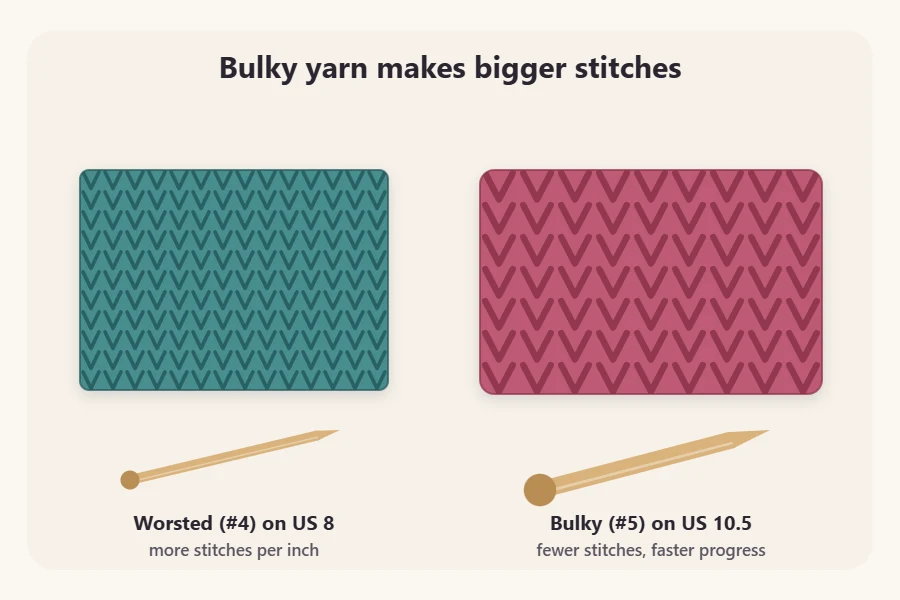
A ball band for worsted yarn typically suggests 16-20 stitches over 4 inches (10 cm) on US 7-9 (4.5-5.5 mm) needles. For bulky yarn it is typically 12-15 stitches over 4 inches on US 9-11 (5.5-8 mm) needles. Fewer stitches per inch means fewer stitches to make for the same piece of fabric, and a thicker, loftier fabric at the end.
Bulky yarn is not automatically the better choice. It makes heavier pieces and uses more yards per square inch than you might expect, and it can feel stiff around the face if knit tightly. Worsted gives a lighter fabric with more drape, which is why it remains the usual choice for a long scarf.
Choosing a warm fiber
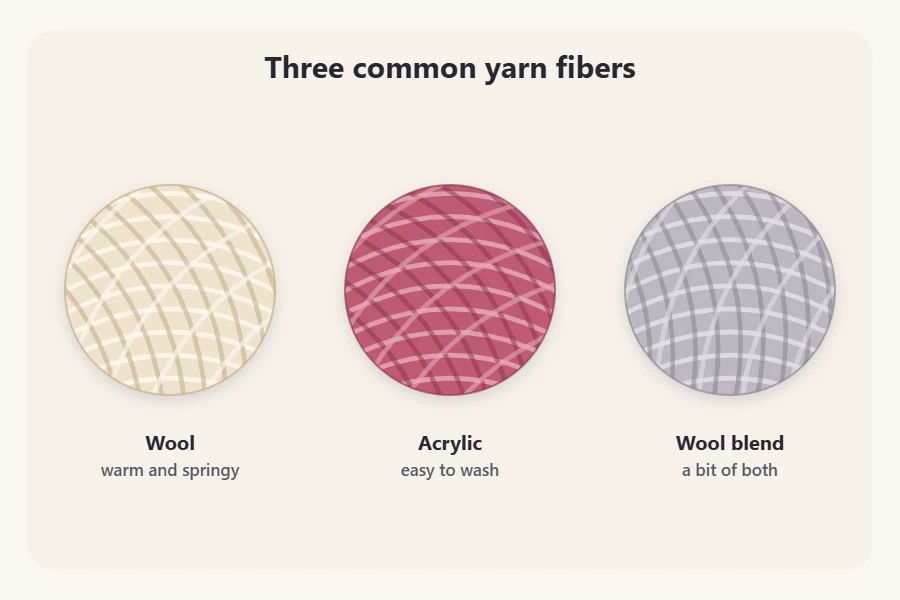
The fiber content on the label affects warmth, feel and washing more than anything else.
| Fiber | Strengths | Things to know |
|---|---|---|
| Wool | Warm, springy and forgiving of uneven stitches | Often needs hand washing unless the label says superwash; some people find it itchy against the neck |
| Acrylic | Usually machine washable, widely available, comes in many colors | Less elastic than wool and does not breathe as well |
| Wool blend | Some of wool’s warmth and spring with easier care | Care varies with the mix, so read the label |
Whichever you pick, look for a smooth yarn in a light or medium color. Dark navy and black are popular for winter accessories, but they make it hard to see your stitches while you are still learning to read them. Fuzzy and novelty yarns have the same problem. The guide to beginner yarn goes into weight, fiber and color in more depth.
Tip
Hold the ball against the inside of your wrist or the side of your neck before you buy. If it feels scratchy there, it will feel scratchy as a scarf.
A ribbed headband to cover your ears
The quickest winter project on this site is the 2×2 rib headband. It takes about 60-70 yards of worsted (#4) yarn on US 8 (5 mm) needles. You cast on 18 stitches, work knit 2, purl 2 ribbing to about 19 inches (48 cm), then seam the short ends together.
Ribbing pulls in and stretches, so the band grips your head without elastic. At about 3.5 inches (9 cm) wide when relaxed, it covers the ears and fits under a hood. A wool or wool blend works best, because an elastic fiber helps the rib spring back after stretching.
A chunky cowl from one skein
A cowl is a scarf with its ends joined, so there is nothing to come unwrapped in the wind. The simple knit cowl uses about 120 yards of bulky (#5) yarn, which is one large skein, on US 10.5 (6.5 mm) needles. Cast on 32 stitches, knit every row until the piece is about 26 inches (66 cm) long, bind off loosely and seam it into a loop about 10 inches (25 cm) tall.
Because a cowl sits right against your neck and chin, softness matters more here than anywhere else. This is the project to choose your gentlest yarn for.
A garter stitch scarf
The garter stitch scarf is knit every row from start to finish: about 200-220 yards of worsted (#4) yarn, US 8 (5 mm) needles, 28 stitches cast on, and about 60 inches (152 cm) of knitting. It comes out about 6 inches (15 cm) wide.
Garter stitch is a good winter fabric. It is thicker than stockinette knit in the same yarn, it lies flat without a border, and it looks the same on both sides, which matters for something that gets wrapped and twisted. It takes longer than the headband or the cowl, so start it early in the season.
A lap blanket for the sofa
When you want a longer project to keep on the go through the cold months, the garter stitch lap blanket is the same knit-every-row fabric at a larger scale. It needs roughly 550-650 yards of bulky (#5) yarn and a US 10.5 (6.5 mm) circular needle, 32 inches or longer, worked back and forth. You cast on 104 stitches and knit to about 40 inches (102 cm) long, for a blanket about 32 inches (81 cm) wide.
One practical bonus is that the growing blanket covers your lap while you work on it.
Planning winter gifts
Hand-knit gifts take longer than most beginners expect, and a deadline is not a relaxing way to learn. A few things help:
- Start with the smallest project. A headband or cowl can be a matter of a few evenings; a scarf or blanket is more likely weeks.
- Buy all the yarn for one project at once and check that the dye lot numbers on the labels match.
- Keep the label. It has the washing instructions, which the person you give the piece to will need.
- Choose machine-washable yarn for anyone who is unlikely to hand wash.
Looking after winter knits
Follow the care symbols on the ball band. If a wool yarn is not marked superwash, wash it by hand in cool water and avoid rubbing or wringing, because heat and agitation can make wool felt and shrink. Press the water out in a towel and dry the piece flat, since hanging a wet scarf or blanket stretches it lengthwise.
Watch out
Wait until after the first wash to trim your woven-in ends close to the fabric. Yarn shifts a little as it settles, and a tail cut too short beforehand can pop out on the right side.
Frequently asked questions
What is the warmest yarn for a beginner to knit with?
Wool and wool blends are the usual choices for warmth, and their natural spring also makes them forgiving to knit. Pick a smooth worsted or bulky yarn in a lighter color so the stitches are easy to see. If easy washing matters more, a soft acrylic is a reasonable alternative.
Is bulky yarn easier for beginners than worsted?
Bulky yarn makes large stitches that are easy to see and a project that grows fast, which many beginners find encouraging. The big needles can feel clumsy in small hands, though. Worsted on US 8 needles is the standard starting point, and either weight is a sound choice.
Can I knit a matching winter set from one yarn?
The scarf and headband on this site both use worsted yarn on US 8 needles, so one color covers both; allow roughly 260-290 yards in total. The cowl and blanket use bulky yarn, so to match them you would need the same shade in a thicker weight.
