First Knitting Projects: What to Knit When You Are Just Starting
A four-step ladder of first knitting projects, from a dishcloth to a chunky cowl, with the yarn, needle size and stitch count for each and a short list of projects worth saving for later.
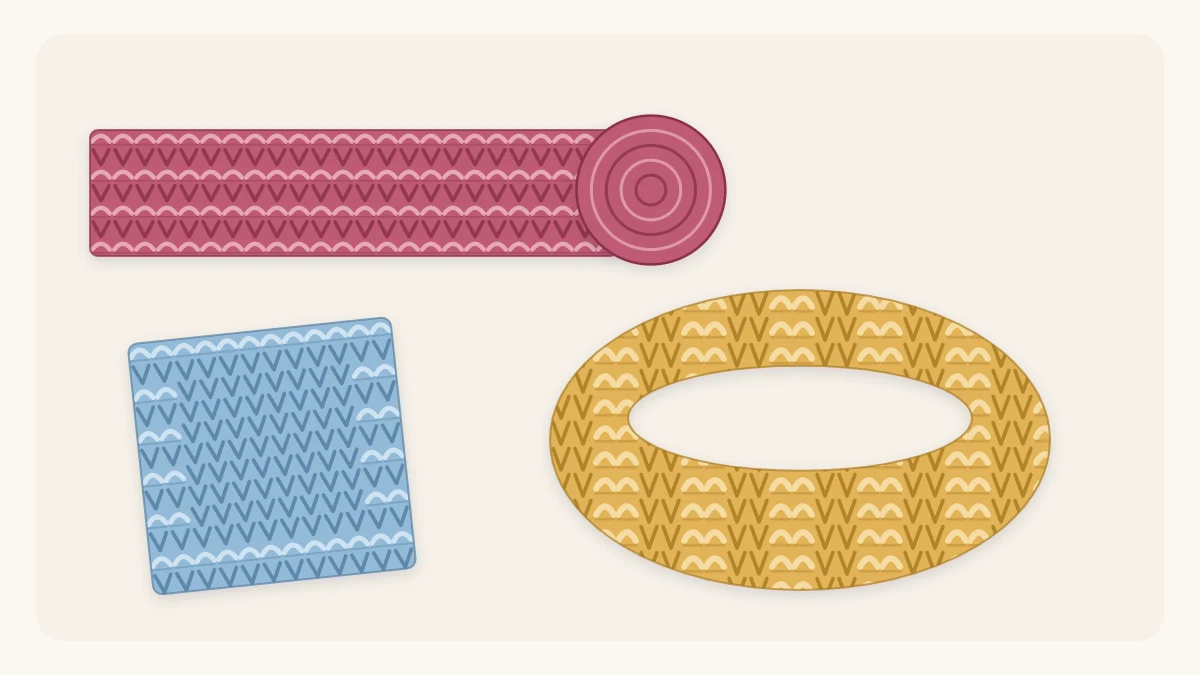
Choosing first knitting projects is mostly a matter of deciding what to leave out. Shaping, knitting in the round and fine yarn can all wait. What you want at the start is a flat piece with straight edges that lets you repeat the same few movements until your hands stop having to think about them.
The four projects below build on one another. Each adds one new skill to the ones before it, and each uses the same handful of tools, so you can work through them in order without buying much along the way.
What makes a good first project
- It is flat and rectangular. Squares and strips need no increases or decreases, only casting on, working rows and binding off.
- It uses medium or thick yarn. Worsted (#4) and bulky (#5) yarns make stitches large enough to see and count.
- The yarn is smooth and light in color. Fuzzy, slippery, very dark or novelty yarns hide the stitches you are trying to learn to read.
- Fit does not matter much. A scarf an inch too wide is still a scarf. A sweater an inch too small is not much use.
- It repeats. Hundreds of the same stitch is what turns an awkward movement into a habit.
If you have not yet made a practice swatch, start with how to start knitting, which walks through the skills in order: cast on, knit, purl, bind off.
A four-step project ladder
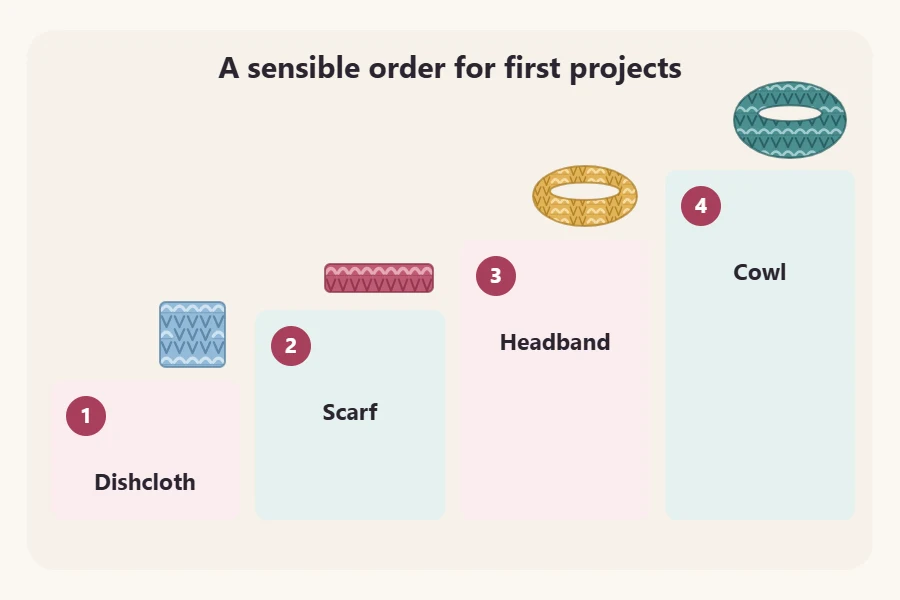
1. A dishcloth
A dishcloth is about 8 inches (20 cm) square, so it is finished before you have time to get bored, and nobody minds if it is a little lopsided. The easy knit dishcloth pattern uses about 60 yards of worsted-weight cotton on US 7 (4.5 mm) needles with 36 stitches cast on. It has a garter-stitch border around a smooth stockinette center, so you practice both knit and purl stitches and see how a border keeps stockinette from curling.
If you have not learned to purl yet, cast on the same 36 stitches and simply knit every row until the cloth is square. It will be just as useful.
2. A garter stitch scarf
The scarf is the classic first project for good reason. It is a single stitch, knit every row, repeated until the piece is about 60 inches (152 cm) long. The garter stitch scarf pattern calls for about 200-220 yards of worsted (#4) yarn, US 8 (5 mm) needles and 28 stitches, giving a scarf about 6 inches (15 cm) wide.
What it teaches is endurance and consistency. Over that many rows your stitches even out, you learn to join a new ball of yarn, and you get plenty of practice keeping a steady stitch count.
3. A ribbed headband
The 2×2 rib headband is small again, about 60-70 yards of worsted yarn on US 8 (5 mm) needles with 18 stitches, but it asks you to switch between knit and purl within the same row. That means moving the yarn between the needle tips every two stitches and learning to tell a knit from a purl at a glance. You also sew your first seam, joining the two short ends of a 19-inch (48 cm) strip.
4. A chunky cowl
The simple knit cowl moves you up to bulky (#5) yarn and US 10.5 (6.5 mm) needles. You cast on 32 stitches, knit every row to about 26 inches (66 cm) and seam the ends into a loop about 10 inches (25 cm) tall. One large skein of about 120 yards is enough. The knitting is easy; the new part is handling thick yarn and big needles, and binding off loosely enough that the edge stretches like the rest.
Yarn and needle pairings at a glance
Thicker yarn needs thicker needles. These are the pairings the patterns on this site use:
| Project | Yarn | Needles | Cast on | Finished size |
|---|---|---|---|---|
| Dishcloth | Worsted-weight cotton, about 60 yd | US 7 (4.5 mm) | 36 sts | About 8 in square |
| Scarf | Worsted (#4), about 200-220 yd | US 8 (5 mm) | 28 sts | About 6 x 60 in |
| Headband | Worsted (#4), about 60-70 yd | US 8 (5 mm) | 18 sts | About 3.5 x 19 in before seaming |
| Cowl | Bulky (#5), about 120 yd | US 10.5 (6.5 mm) | 32 sts | About 10 x 26 in before seaming |
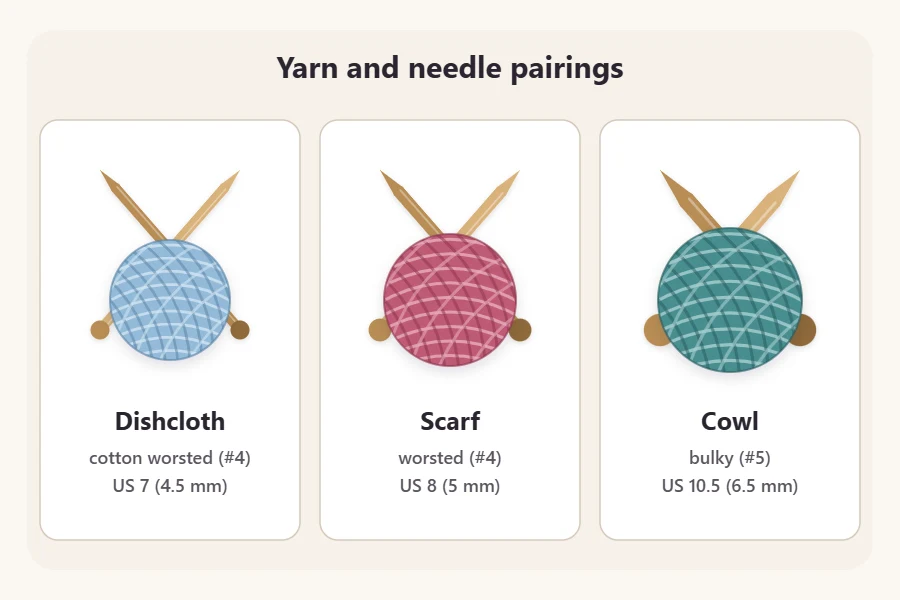
The dishcloth uses a slightly smaller needle than the scarf even though both yarns are worsted weight. Cotton has little stretch, and a firmer fabric makes a better cloth for scrubbing.
When you want something bigger
Once the cowl is done, a lap blanket is well within reach. It uses the same bulky yarn and US 10.5 (6.5 mm) needle size, with 104 stitches worked back and forth on a long circular needle. Nothing about it is harder than the scarf. It simply takes longer and needs roughly 550-650 yards of yarn.
Projects to save for later
Some popular projects look simple but stack several new skills at once. They are worth waiting for:
- Hats are usually knit in the round and need decreases to shape the crown.
- Socks use fine yarn, small needles and a turned heel.
- Sweaters depend on accurate gauge, the number of stitches per inch, to fit.
- Lace shawls rely on yarn overs and decreases worked from a chart.
None of these is out of reach. Each one just goes more smoothly after a few flat projects.
Habits that make any first project go better
- Count your stitches every few rows. An accidental extra stitch is easy to fix when you catch it early.
- Stop at the end of a row, not in the middle, so you always know which direction you were going.
- Bind off loosely. A needle one or two sizes larger in your right hand helps.
- Leave 6-inch tails wherever you start or end a ball of yarn, so there is enough to weave in.
- Expect the first few inches to look uneven. Evenness comes with repetition, and washing the finished piece smooths out a good deal of it.
Tip
Buy yarn for one project at a time. Finishing something small tells you more about which yarn and needles you enjoy than any amount of planning.
Frequently asked questions
Should my first knitting project be a scarf or a dishcloth?
Either works. A dishcloth is small and finished fast, which suits you if you want a quick result and are ready to try purling. A scarf needs only the knit stitch but many more rows, so it suits you if you would like long, steady practice.
How long does a first knitting project take?
It varies a lot with how often you knit and how quickly your hands settle in. As a rough guide, a dishcloth or headband may take a few evenings, while a full-length scarf can take a few weeks of occasional knitting. Speed tends to improve noticeably during the first project.
Can I knit a hat as my very first project?
It is possible, but most hats are knit in the round and shaped with decreases, so you would be learning several things at once. Making one or two flat pieces first means that casting on, knitting, purling and binding off already feel familiar when you add those new skills.

