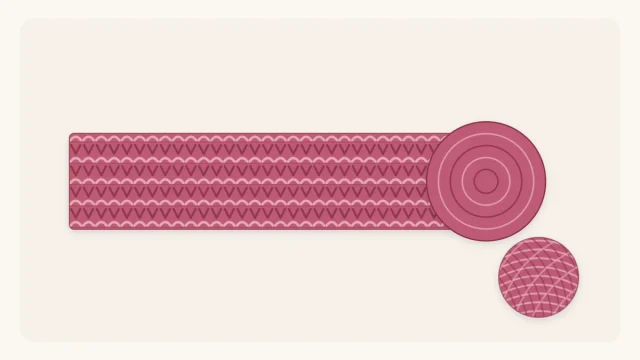
Easy Knit Dishcloth Pattern: A Perfect First Project
Knit an 8-inch cotton dishcloth with a smooth stockinette center and a garter-stitch border. The pattern uses about 60 yards of yarn and practices both the knit and the purl stitch.

Tutorial at a glance
Materials
- About 60 yd worsted-weight cotton yarn
- US 7 (4.5 mm) knitting needles
- Tapestry needle
- Scissors
- Tape measure
- Locking stitch marker
A dishcloth is small, quick and useful, and no one minds if it turns out slightly crooked. This easy knit dishcloth pattern takes one small ball of cotton and combines the two basic stitches, knit and purl, in a square you can finish in a couple of sittings.
It is also a gentle step up from all-knit projects. The center is smooth stockinette, the edges are garter stitch, and you will see for yourself why a border matters.
Finished size and materials
The finished cloth is about 8 inches (20 cm) square.
- Yarn: worsted-weight cotton (medium, #4), about 60 yards. A light, solid color makes the stitches easy to see.
- Needles: US 7 (4.5 mm), straight or a circular needle used flat.
- Notions: tapestry needle, scissors, tape measure and one locking stitch marker.
Cotton is the right fiber for this job because it absorbs water well and stands up to repeated washing. It has little stretch, though, so it feels firmer on the needles than wool and shows uneven stitches more. Keep your hands relaxed. There is more about the fiber in the guide to knitting with cotton yarn.
Gauge
Gauge is the number of stitches per inch. This cloth works out to about 18 stitches per 4 inches (10 cm) in stockinette. It is not critical here. Looser knitting just makes a slightly larger cloth and uses a little more yarn.
Abbreviations
- CO: cast on
- k: knit
- st(s): stitch(es)
- RS: right side, the smooth side that faces out
- WS: wrong side, the bumpy side
- BO: bind off
How the dishcloth is built
The square has three parts: a bottom border of garter stitch, a center panel of stockinette with three garter stitches at each side, and a matching top border.

The border is not just decoration. On its own, stockinette stitch curls at the edges. A frame of garter stitch, which lies flat, holds the square open.
The pattern
- CO 36 sts.
- Bottom border: knit 4 rows.
- Row 1 (RS): knit all sts.
- Row 2 (WS): k3, purl to last 3 sts, k3.
- Repeat Rows 1 and 2 until the piece measures about 7.5 inches (19 cm) from the cast-on edge, ending after a WS row.
- Top border: knit 4 rows.
- BO all sts. Cut the yarn, leaving a tail of about 6 inches, and pull it through the last loop.
Step-by-step notes
Cast on and bottom border
Use the long-tail cast-on. Allow roughly 1 inch of tail per stitch plus about 6 inches, so start with about 42 inches of tail. Then knit 4 rows. You will see two garter ridges form above the cast-on edge.
Mark the right side
Before you work Row 1, clip the locking marker to the side of the fabric facing you. That is the right side. Whenever the marker faces you, knit the whole row. When it is on the far side, work Row 2.
Row 2, the only row that needs attention
Knit 3 stitches with the yarn in back. Bring the yarn to the front between the needle tips, not over the needle. Purl until 3 stitches remain on the left needle. Take the yarn to the back between the tips and knit those last 3.
The purl stitch is worked with the yarn in front: insert the right needle from right to left into the front of the stitch, wrap counterclockwise, push the new loop through to the back and slide the old stitch off.
Watch out
If the yarn travels over the needle when you move it, you make an accidental yarn over, which is an extra stitch with a hole below it. Count your stitches after every few WS rows. You should always have 36.
Reading your knitting
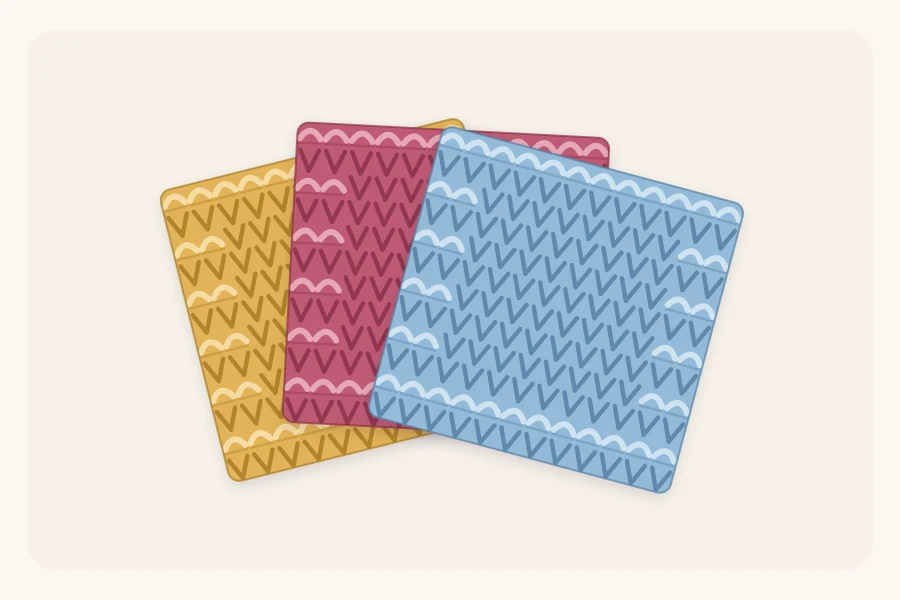
After a few repeats you will not need the marker. On the right side, the center shows smooth Vs. On the wrong side, it shows rows of bumps. The three stitches at each side show garter ridges on both faces, because they are knit on every row.
If you lose your place, look at the center panel facing you. Smooth Vs mean you are on a RS row, so knit across. Bumps mean a WS row, so work k3, purl, k3.
Top border and bind-off
Lay the piece flat and measure. At about 7.5 inches, with a WS row just completed, knit 4 rows for the top border. Then bind off with the right side facing: knit 2, lift the first stitch over the second, knit 1, lift over, and repeat to the end.
Cotton does not give, so a tight bind-off will pull the top edge in. Keep it loose, or hold a needle one or two sizes larger in your right hand.
Finishing
Thread each tail onto the tapestry needle and weave it in on the wrong side for about 2 inches, changing direction once. Cotton is smooth and tails can work loose in a cloth that gets scrubbed, so let the needle split the yarn of a few stitches as you go for extra grip.
Wash the cloth before you trim the tails. Cotton usually tightens a little in the first wash, and the stitches even out. Then snip the ends close to the fabric.
Tip
If one side border looks looser than the other, give the yarn a slightly firmer pull on the first purl stitch after the k3. The change from knit to purl is where slack tends to collect.
Ways to change the pattern
- All garter: knit every row for a thicker, more textured cloth. It will be a bit wider on the same 36 stitches and uses more yarn.
- Smaller or larger: cast on any number of stitches. Keep 3 border stitches at each side and work until the piece is as tall as it is wide.
- Striped: change colors at the start of a RS row so the color change is crisp on the right side.
- A set: one larger ball of cotton often yields two or three cloths. Check the yardage on the label against the 60 yards each one needs.
Frequently asked questions
What is the best yarn for a knitted dishcloth?
Worsted-weight cotton is the usual choice. It soaks up water, can be washed again and again, and holds up to scrubbing. Acrylic does not absorb water well and can be damaged by hot pans, and wool can felt and shrink with hot water and rubbing, so both are better kept for other projects.
How many stitches do I cast on for a dishcloth?
This pattern casts on 36 stitches in worsted-weight cotton on US 7 (4.5 mm) needles, which makes a cloth about 8 inches wide. For a different size, cast on more or fewer stitches, keep three garter stitches at each edge, and knit until the piece is square.
Why is my dishcloth not square?
Check the stitch count first. Accidental yarn overs between the knit border and the purled center add stitches and widen the cloth. If the count is right, measure the piece lying flat, since a knit stitch is wider than it is tall and equal numbers of rows and stitches do not make a square. Work until the height matches the width before starting the top border.