How to Cast On Knitting: The Long-Tail Cast-On Step by Step
Learn the long-tail cast-on from the slipknot to a full row of stitches: how much tail to leave, how to hold the yarn, the four moves for each stitch and how to keep the edge loose.

Tutorial at a glance
Materials
- Smooth, light-colored worsted-weight yarn
- One US 8 (5 mm) needle, wood or bamboo
- Scissors
Learning how to cast on knitting stitches is the first real step of any project. Casting on puts the foundation row of loops on your needle so that you have something to knit into. There are many ways to do it, but the long-tail cast-on is the one worth learning first.
It is fast, it makes a tidy edge with some stretch, and it suits almost everything a beginner makes, from scarves to dishcloths. The hand position looks odd at first. Give it ten or fifteen slow repetitions and it starts to feel like one motion.
What you need
- Smooth, light-colored worsted-weight yarn (medium, weight number 4)
- One US 8 (5 mm) needle, ideally wood or bamboo
You cast on with a single needle. The second needle waits until you knit the first row.
Measure the tail
The long-tail cast-on uses two strands at once: the tail (the loose end) and the working yarn (the strand attached to the ball). The tail gets used up as you go, so it has to be long enough before you start.
For worsted-weight yarn, allow roughly 1 inch (2.5 cm) of tail for each stitch, plus about 6 inches (15 cm) extra to weave in later. For 20 stitches, that is about 26 inches (66 cm). Thicker yarn needs more per stitch and thinner yarn a little less.
Tip
For a quick estimate with any yarn, wrap it around the needle ten times, unwind it and note the length. That is roughly what ten stitches use. Multiply for your stitch count, then add about 6 inches.
Make a slipknot
- Measure out your tail and pinch the yarn at that point.
- Make a loop there by crossing the yarn over itself.
- Reach through the loop, pinch the strand that leads to the ball, and pull a new loop of it through.
- Put the new loop on the needle and pull gently on both strands until it sits close to the needle.
The slipknot should slide along the needle easily. It counts as your first stitch.

Set up your hands
This position is often called the slingshot, because the yarn forms a V between your fingers.
- Hold the needle in your right hand and rest your index finger on the slipknot to keep it from spinning. Let the tail hang on the side nearer to you and the working yarn on the far side.
- Put your left thumb and index finger between the two strands. The tail goes over your thumb and the working yarn goes over your index finger.
- Catch both strands against your palm with your other three fingers.
- Spread your thumb and finger apart and turn your palm toward you. Each strand now makes a loop around a finger.
Cast on a stitch
- Under the thumb. Bring the needle tip toward you and slide it up under the strand on the outside of your thumb, so the tip is inside the thumb loop.
- Over the finger. Move the tip across to your index finger and take it over the top of the nearer strand there, catching that strand from right to left.
- Back through. Draw the caught strand down through the thumb loop and toward you.
- Release. Drop the loop off your thumb. Put your thumb back under the tail and spread your fingers to snug the new stitch against the needle.
That is one stitch. Your hand is already back in the slingshot position, so repeat the four moves for each stitch you need. Remember that the slipknot is stitch one: for 20 stitches, you make 19 more.

Keep it loose and even
The most common cast-on problem is tightness. Stitches that grip the needle are hard to get a needle tip into, and they leave a bottom edge that pulls in.
- Snug each stitch only until it meets the needle. Do not pull hard.
- Leave a small gap between stitches, about the width of the needle, instead of pushing each new stitch tight against the last one.
- Check as you go. You should be able to slide the whole row along the needle with one finger.
Evenness comes from how you hold the yarn, and it improves with repetition. The guide to knitting tension has more on finding a comfortable hold.
Fixing common problems
You ran out of tail
There is no tidy way to add more tail. Slide the stitches off, pull them out and start again with a longer one. It happens to everyone.
You have a lot of tail left
That is fine. Leave about 6 inches for weaving in and trim the rest once the project is finished.
The first stitch is baggy
Pull on the tail to tighten the slipknot. If it does not tighten, it will be tidied later when you weave in the ends.
What to do next
Move the needle full of stitches to your left hand and pick up the empty needle in your right. You are ready for the first row of the knit stitch.
Watch out
Two strands hang from your first stitch. Knit with the working yarn, not the tail. If the yarn you are using runs out after a few stitches, you picked up the tail by mistake.
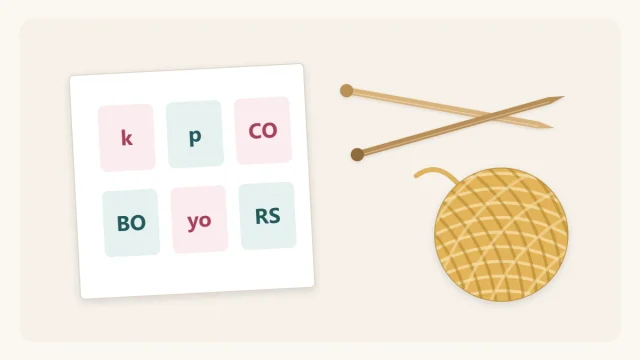
In written patterns, cast on is shortened to CO and stitches to sts, so “CO 28 sts” means cast on 28 stitches. That is the opening line of the easy garter stitch scarf pattern, which needs a tail of roughly 34 inches (86 cm). The full list of shorthand is in knitting abbreviations explained.
Frequently asked questions
How long should the tail be for a long-tail cast-on?
In worsted-weight yarn, plan on roughly 1 inch of tail for every stitch, then add about 6 inches so there is enough left to weave in. Bulky yarn uses more per stitch and finer yarn uses less. When in doubt, be generous, because a tail that is too short means starting over.
Does the slipknot count as a stitch?
Yes. In the long-tail cast-on, the slipknot sits on the needle like any other loop and is counted as stitch number one. If a pattern asks for 28 stitches, you make the slipknot and then cast on 27 more. Count the loops on the needle before you begin the first row.
Why is my cast-on so tight?
Usually because each stitch is pulled hard against the needle and pushed right up to its neighbor. Tighten a new stitch only until it touches the needle, and leave a small space before the next one. The finished row should slide along the needle when you nudge it with a finger.