How to Start Knitting: A Beginner’s Roadmap
A clear roadmap for complete beginners: the five things to buy, the four skills to learn in order (cast on, knit, purl, bind off) and a first project you can finish.
Tutorial at a glance
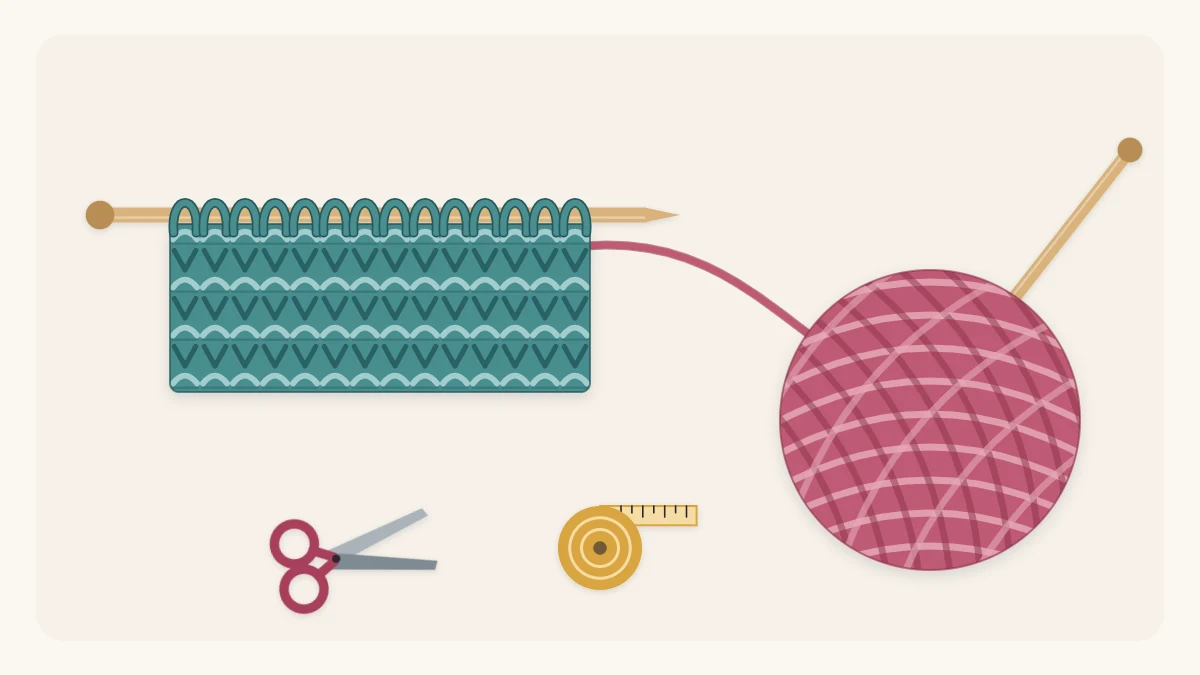
Materials
- 1 ball of smooth, light-colored worsted-weight yarn
- US 8 (5 mm) wood or bamboo needles
- Tapestry needle
- Scissors
- Tape measure
If you are wondering how to start knitting, the short answer is: with one ball of yarn, one pair of needles and four small skills. Everything else in knitting, from scarves to sweaters, is built out of those same four moves repeated in different orders.
This roadmap puts those skills in the order that makes them easiest to learn, tells you what to buy (it is a short list), and points you to a first project you can actually finish. You do not need to be naturally crafty. You need about twenty minutes at a time and a willingness to make a lumpy first swatch.
What you need to start
Craft stores are full of tempting things, but a beginner kit is only five items.
- One ball of worsted-weight yarn. Worsted is weight number 4 (medium) on the standard yarn weight scale. Pick a smooth wool, wool blend or acrylic in a light color so you can see every stitch.
- A pair of US 8 (5 mm) needles. Wood or bamboo grips the yarn better than metal, so stitches are less likely to slide off while you learn. Straight needles 9 to 10 inches (23 to 25 cm) long are easy to manage.
- A tapestry needle. This blunt needle with a large eye tucks away the yarn ends when you finish.
- Scissors. Any small, sharp pair will do.
- A tape measure. You will use it to check the length and width of your work.

Avoid fuzzy, slippery, very dark or novelty yarn at first. All of them make stitches hard to see or hard to control. The guide to the best yarn for beginner knitters explains how to read a yarn label before you buy.
The four skills, in order
Every flat piece of knitting has the same life cycle: stitches go onto a needle, you work them row after row, and you take them off in a way that will not unravel. That gives you four things to learn.
- Cast on to put the first row of loops on a needle.
- The knit stitch, which on its own makes a ridged fabric called garter stitch.
- The purl stitch, which combines with the knit stitch to make smooth stockinette stitch.
- Bind off to close the last row so the piece can come off the needles.

Take them one at a time. There is no need to hurry on to the purl stitch, because plenty of good first projects use only steps 1, 2 and 4.
Step 1: Cast on
Casting on creates your foundation row. The long-tail cast-on is the method most beginners learn first because it is quick once it clicks and it makes a neat edge with some stretch. It starts with a slipknot, which counts as your first stitch, and it uses two strands: the tail (the loose end) and the working yarn (the strand that runs to the ball).
For practice, cast on 20 stitches. Keep them loose enough to slide along the needle. A tight cast-on is a very common reason a first row feels impossible. The full walkthrough is in how to cast on.
Step 2: Learn the knit stitch
The knit stitch is four motions, remembered as In, Around, Through, Off. With the working yarn held behind the needles, the right needle goes into the first stitch on the left needle, the yarn wraps around the right needle, the new loop comes through, and the old stitch slides off.
Knit every stitch of every row and you get garter stitch: a squishy, reversible fabric of horizontal ridges that lies flat. Stay here for a while. Work 20 or 30 rows, and go back to the step-by-step guide to the knit stitch whenever your hands forget what comes next.
Step 3: Add the purl stitch
A purl is a knit stitch made from the other side. The yarn sits in front of the needles instead of behind them, and the right needle enters the stitch from right to left. A purl leaves a small bump facing you, where a knit leaves a smooth V.
Knit one row, purl the next, and repeat. That is stockinette stitch, the smooth fabric of most sweaters. Its edges curl, which is normal behavior for that fabric and not a mistake on your part.
Step 4: Bind off
Binding off secures the live loops. Knit two stitches, lift the first one over the second and off the needle, knit one more, lift over again, and continue across the row. Cut the yarn, leaving about a 6-inch (15 cm) tail, and pull it through the last loop. Work loosely so the edge stretches as much as the rest of the fabric.
Tip
You can bind off a garter swatch before you ever learn to purl. Finishing one small square early shows you the whole process from the first loop to the last.
How to practice so it sticks
- Keep sessions short. About 15 to 20 minutes on most days tends to work better than one long, frustrating afternoon.
- Count your stitches every few rows. If 20 has become 22, you have caught the problem while it is still easy to fix.
- Relax your grip. Tight hands make tight stitches, and tight stitches are hard to work into.
- Keep your first swatch, however uneven it is. It is a useful comparison for later ones.
Holes, extra stitches and a swatch that grows wider are part of learning, and each has a simple cause. Common knitting mistakes explains what happened and how to put it right.
Choose a first project
Once your knit stitches feel steady, make something real. A garter stitch scarf is the classic choice because it uses only steps 1, 2 and 4. You need about 200 to 220 yards of worsted-weight yarn and US 8 (5 mm) needles. Cast on 28 stitches, knit every row until the scarf is about 60 inches (152 cm) long, then bind off loosely. It comes out about 6 inches (15 cm) wide.
The easy garter stitch scarf pattern has the full instructions. If a scarf sounds long, a cotton dishcloth is a smaller project that adds a little purling.
Frequently asked questions
Is knitting hard to learn?
The basic movements are simple, but they feel clumsy at first because your hands are doing something unfamiliar. Most of the early difficulty comes from holding the yarn too tightly. With short, regular practice sessions on a small swatch, the motions become smoother and your stitches gradually even out.
What should I knit first?
Start with a practice swatch of about 20 stitches so mistakes do not matter. After that, a garter stitch scarf is a good first project because it uses only casting on, the knit stitch and binding off. A cotton dishcloth is a smaller option that also introduces a little purling.
Should a beginner use straight or circular needles?
Either works. Straight needles about 9 to 10 inches long are simple to understand and fine for narrow pieces like scarves. A circular needle 24 to 32 inches long can be used back and forth in exactly the same way, and it holds the weight of a wider project more comfortably in your lap.