Knitting Abbreviations Explained: A Plain-English Glossary
A plain-English glossary of the knitting abbreviations beginners meet first, from k and p to k2tog and ssk, plus how asterisks, brackets and stitch counts work in a pattern row.
Open your first pattern and it can read like a secret code: “CO 28 sts. K every row.” Knitting abbreviations are simply shorthand that keeps a pattern short enough to fit on a page, and there are far fewer of them than it first appears. A beginner pattern usually leans on about a dozen.
This glossary covers the ones you will meet first, written the way US patterns write them, with a plain-English meaning for each. Keep it nearby while you work, and the shorthand soon starts to read like ordinary words.
Why patterns use abbreviations
Written out in full, one row might say: “Knit two stitches, purl two stitches, and keep repeating those four stitches until you reach the end of the row.” In shorthand that becomes “*k2, p2; rep from * to end.” Once you know the letters, the short version is easier to follow.
Most patterns list the abbreviations they use near the top. Read that list before you start, since a designer may add a term of their own. Capital letters do not change the meaning: K2 and k2 are the same instruction.
The core abbreviations at a glance
These terms appear in nearly every beginner pattern.
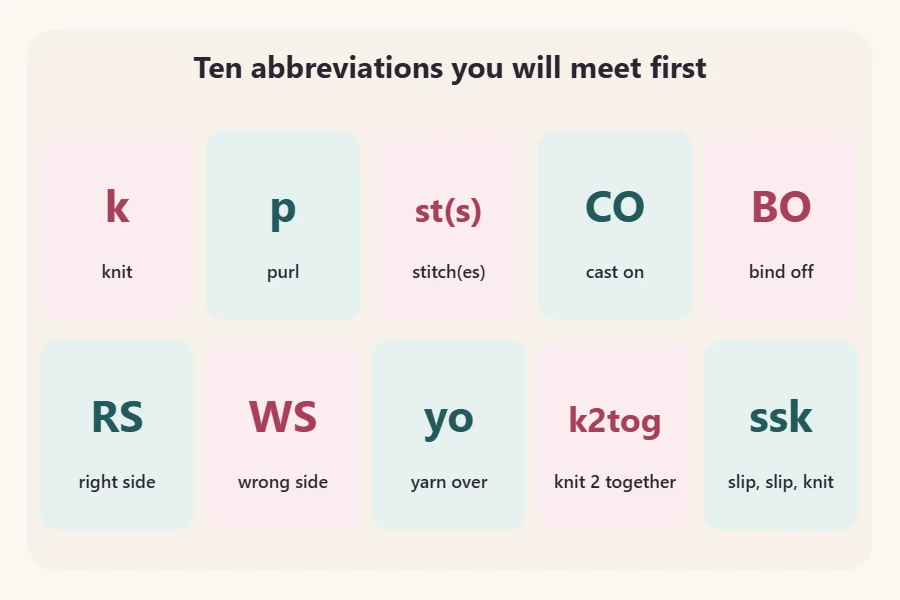
| Abbreviation | Stands for | What you do |
|---|---|---|
| k | knit | Make a knit stitch. k3 means knit three stitches. |
| p | purl | Make a purl stitch. p2 means purl two stitches. |
| st(s) | stitch(es) | The loops on your needle. “28 sts” is 28 stitches. |
| CO | cast on | Put the starting stitches on the needle. |
| BO | bind off | Close the live stitches so they cannot unravel. |
| RS | right side | The side of the fabric meant to be seen. |
| WS | wrong side | The inside or back of the fabric. |
| rep | repeat | Work the same group of stitches again. |
| sl | slip | Move a stitch to the right needle without working it. |
| pm | place marker | Slide a stitch marker onto the right needle. |
| sm | slip marker | Move the marker from the left needle to the right. |
| yo | yarn over | Wrap the yarn over the right needle to add a stitch and a small hole. |
| kfb | knit front and back | Knit into the front and then the back of one stitch to make two. |
| M1L / M1R | make 1 left / make 1 right | Lift the strand between two stitches and knit it twisted. |
| k2tog | knit 2 together | Knit two stitches as if they were one. Leans right. |
| ssk | slip, slip, knit | Slip two stitches knitwise one at a time, then knit them together through the back loops. Leans left. |
Stitches and setup: k, p, st(s), CO, BO
The two letters you will read most are k and p, for the knit stitch and the purl stitch. A number straight after the letter is a count, so “k5, p1” means knit five stitches, then purl one. With no number, as in “knit to end,” you keep going until the row runs out.
CO and BO bracket every project. “CO 28 sts” tells you to cast on 28 stitches. “BO loosely” tells you to bind off without pulling the yarn tight, so the finished edge stretches as much as the rest of the fabric.
Sides of the fabric: RS and WS
RS is the face that shows when the piece is worn or used. WS is the inside. Patterns label rows so you know which side should be facing you as you work: “Row 1 (RS): knit” means the right side is toward you for that row.
Shaping: yo, kfb, M1L, M1R, k2tog, ssk
Shaping abbreviations change your stitch count. Increases add a stitch. A kfb leaves a small bar that looks like a purl bump, M1L and M1R are nearly invisible, and a yo leaves a deliberate hole, which is how eyelets and lace are made.
Decreases each remove one stitch. A k2tog slants to the right and an ssk slants to the left, so patterns often pair them at opposite edges to keep a shape symmetrical.
Housekeeping: sl, pm, sm
To slip a stitch, move it from the left needle to the right without knitting or purling it. Unless the pattern says otherwise, slip it purlwise: insert the right needle as if to purl, so the stitch crosses over untwisted.
Stitch markers are small rings that sit on the needle between stitches to flag a spot, such as the edge of a border. “pm” tells you to put one on. “sm” tells you to pass it across when you reach it and carry on. A marker is never counted as a stitch.
Repeats: rep, asterisks and brackets
An asterisk marks the start of a repeat. In “*k1, p1; rep from * to end,” you knit one, purl one, then jump back to the asterisk and work the same two stitches again, over and over, until the row is finished.
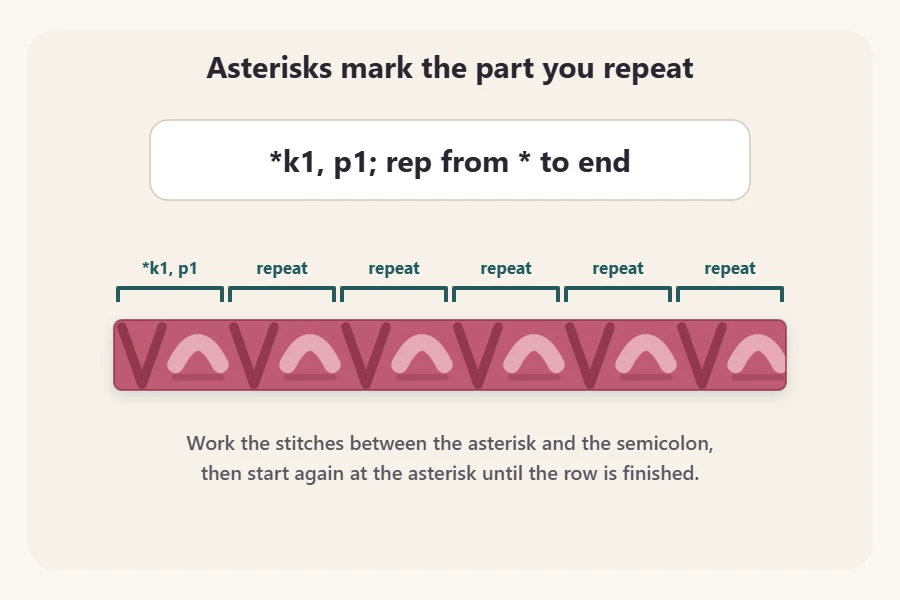
Sometimes the repeat stops early: “rep from * to last 2 sts, k2” means stop repeating when two stitches remain, then knit those two. Brackets or parentheses do a similar job for short groups. “(k2, p2) 4 times” means work what is inside four times in a row.
A number in parentheses at the end of a row, such as “(30 sts),” is the stitch count you should have once that row is done. Counting at that point is the quickest way to catch a mistake.
Tip
Decode one row before you knit it. On 18 stitches, “*k2, p2; rep from * to last 2 sts, k2” works out as knit 2, purl 2 four times (16 stitches), then knit the last 2.
A few longer terms you will also see
- tbl: through the back loop. Work into the back leg of the stitch instead of the front.
- kwise / pwise: knitwise or purlwise. Insert the needle as if to knit, or as if to purl.
- work even: continue in the same stitch pattern with no increases or decreases.
When you meet a term that is not listed here, the Craft Yarn Council publishes the standard list of knitting abbreviations used across the US industry. For the rest of the page around the row instructions, such as materials, gauge and sizing, see how to read a knitting pattern.
Frequently asked questions
Do I have to memorize every knitting abbreviation before I start?
No. Learn k, p, st(s), CO and BO first, since those five are enough for a plain scarf. Add the others as patterns ask for them. Most patterns print their own abbreviation list near the top, so you can look terms up as you go instead of memorizing them ahead of time.
What does the asterisk mean in a knitting pattern?
An asterisk marks the first stitch of a group that gets repeated. When the row says "rep from *," go back to the asterisk and work the same stitches again. Keep doing that until the row ends, or until you reach the number of stitches the pattern tells you to leave unworked.
Are US and UK knitting abbreviations the same?
Most of the short forms, such as k, p, k2tog and yo, are shared. A few terms and stitch names differ between the two, and needle sizes are numbered differently, so check where a pattern was written. The abbreviation list and the millimeter needle size printed in the pattern will settle any doubt.