Knitting Decreases for Beginners: K2tog and SSK
Learn the two decreases behind most beginner shaping: k2tog, which leans right, and ssk, which leans left. Includes numbered steps, how to pair them and a practice swatch.

Tutorial at a glance
Materials
- Smooth, light-colored worsted-weight yarn
- US 8 (5 mm) needles
- Scissors
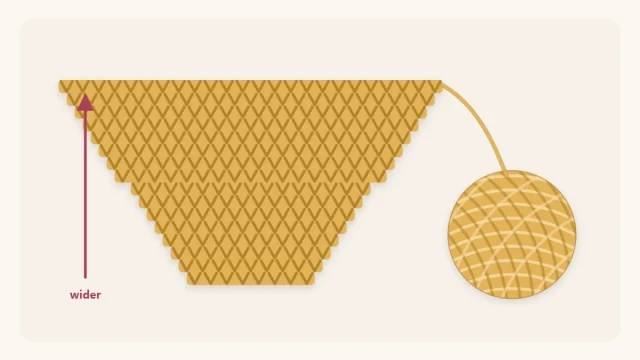
Knitting decreases remove stitches from a row so the fabric gets narrower. They shape the crown of a hat, the toe of a sock, the neckline of a sweater and the point of a triangle.
Two decreases handle nearly all beginner shaping: knit two together, written k2tog, and slip, slip, knit, written ssk. Each turns two stitches into one. The difference is the direction in which the finished stitch leans, and that is what makes shaping look tidy.
Why the lean matters
When two stitches are knit into one, one of them ends up lying on top of the other. The top stitch slants, and a column of decreases forms a visible diagonal line.
- K2tog leans to the right.
- Ssk leans to the left.
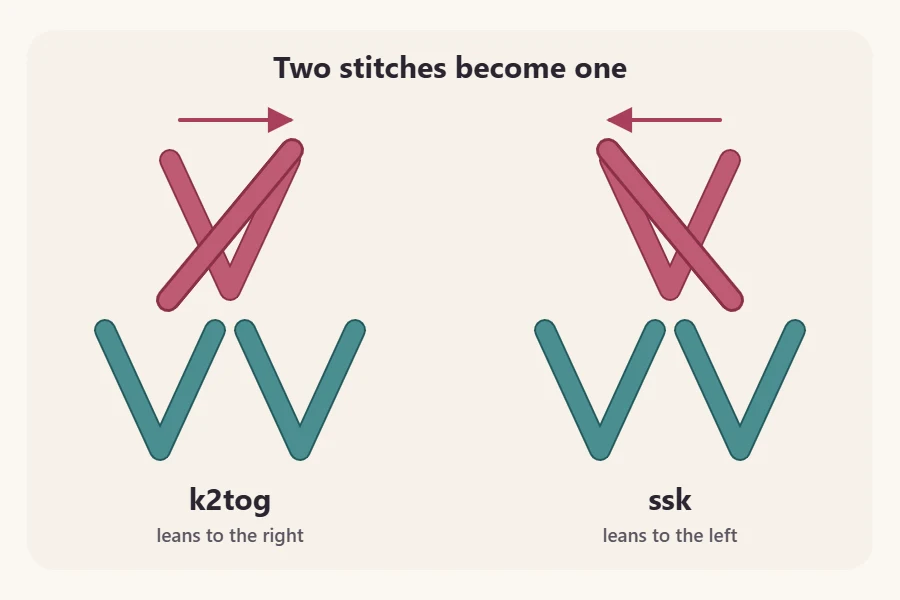
Used as a pair, they give symmetrical shaping. Used alone, either one narrows the fabric perfectly well; it just slants one way.
Both are worked on the knit side of the fabric and both build on the knit stitch. For practice, use smooth worsted-weight (#4) yarn in a light color and US 8 (5 mm) needles.
Knit two together (k2tog)
K2tog is exactly what it sounds like: a knit stitch worked through two stitches at once.
- Keep the working yarn in back, as for any knit stitch.
- Insert the right needle from left to right through the first two stitches on the left needle together. The tip goes into the second stitch first, then the first.
- Wrap the yarn counterclockwise around the right needle.
- Pull the new loop through both stitches.
- Slide both old stitches off the left needle.
One stitch now sits on the right needle where there were two, and it leans to the right.
If you cannot get the needle through two stitches, your knitting is probably tight. Push both stitches up toward the tip of the left needle first, and see the guide to knitting tension for longer-term help.
Slip, slip, knit (ssk)
Ssk is the left-leaning partner. It has an extra step because the two stitches must be turned around before they are knit together.
To slip a stitch (abbreviated sl) means to move it from the left needle to the right without working it. “Knitwise” means you insert the right needle as if to knit, from left to right.
- Slip the first stitch knitwise onto the right needle.
- Slip the next stitch knitwise as well. Slip them one at a time, not together.
- Insert the tip of the left needle into the fronts of both slipped stitches, from left to right. The right needle is now sitting behind the left needle, through the back loops.
- Wrap the yarn counterclockwise around the right needle and knit the two stitches together.
- Slide both off. One left-leaning stitch remains.
Watch out
Slipping the two stitches together in one move, or slipping them as if to purl, changes the result. The decrease will look twisted or will not lie flat. Slip knitwise, one stitch at a time.
An ssk often looks a little looser than a k2tog. That is common and tends to settle after the piece is washed. Avoid stretching the stitches as you slip them.
Pairing decreases for symmetrical shaping
To narrow a piece evenly on both sides, patterns place one decrease near each edge. The usual arrangement on a right side (RS) row is:
- Ssk near the start of the row, so the line of decreases slants inward toward the center.
- K2tog near the end of the row, so its line slants inward from the other side.
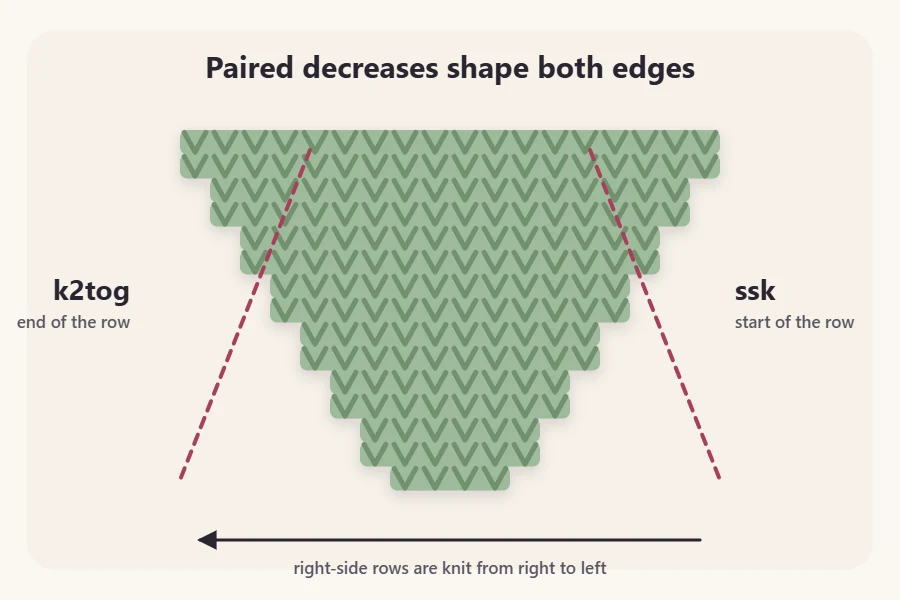
Decreases are normally worked one or two stitches in from the edge rather than on the edge stitch itself. That leaves a clean border that is easy to seam.
How decreases change your stitch count
Each k2tog or ssk uses two stitches from the left needle and leaves one on the right. Your count drops by one for every decrease.
A row with one ssk and one k2tog is therefore two stitches shorter than the row before. Count at the end of each decrease row; it takes seconds and catches a missed decrease while it is still easy to fix. If you need to go back a few stitches, how to undo knitting explains how to do it without losing your work.
Patterns often tell you the new total in parentheses at the end of the row, for example “(18 sts),” where “sts” is short for stitches.
A practice swatch
This swatch narrows from a wide base, so you can see both decreases doing their work. “K1” means knit one stitch.
- Cast on 20 sts.
- Knit one row, then purl one row.
- Decrease row (RS): k1, ssk, knit until 3 sts remain, k2tog, k1. You have removed 2 sts.
- Next row, wrong side (WS): purl every stitch.
- Repeat steps 3 and 4 six more times. You should have 6 sts.
- Bind off.
Look at the right side. Along the right-hand edge you should see a line of left-leaning stitches, and along the left-hand edge a line of right-leaning ones, both pointing toward the top center.
Decreases you will meet later
Once these two feel familiar, others follow the same logic. P2tog (purl two together) is a decrease worked on a purl row; seen from the right side it leans right, like a k2tog. In lace, a decrease is usually paired with a yarn over so the number of stitches stays the same while a pattern of holes forms.
The opposite skill, adding stitches, is covered in knitting increases for beginners. For a quick reminder of any shorthand, keep the knitting abbreviations glossary open beside your pattern.
Frequently asked questions
What is the difference between k2tog and ssk?
Both turn two stitches into one. K2tog knits the two stitches together as they sit, and the result leans to the right. For ssk you slip two stitches knitwise one at a time, then knit them together through the back loops, and the result leans to the left.
Can I use k2tog everywhere instead of ssk?
The stitch count will still be correct, so the piece will come out the right size. The shaping will look lopsided, though, because every decrease slants the same way. Where a pattern asks for ssk on one side and k2tog on the other, following it gives matching edges.
Why does my ssk look messier than my k2tog?
It is a common observation. The slipped stitches get handled more and can stretch a little, so the top stitch looks looser. Slip gently without pulling the stitches wide, keep them near the needle tips, and expect some of the difference to even out once the finished piece is washed.