How to Do the Knit Stitch: A Step-by-Step Guide for Beginners
Learn the knit stitch in four motions: In, Around, Through, Off. Covers how to hold the needles, where the yarn goes, how to turn at the end of a row and how to fix tight or extra stitches.
Tutorial at a glance
Materials
- Smooth, light-colored worsted-weight yarn
- US 8 (5 mm) wood or bamboo needles
- Scissors
The knit stitch is the foundation of all knitting. Learn this one movement and you can already make a scarf, a cowl or a blanket, because a whole family of beginner projects uses nothing else.
The movement has four parts, and on this site they have a name: In, Around, Through, Off. Say the words out loud as you work your first rows. It feels a little silly, and it helps your hands remember the order.
Before you begin
You need smooth, light-colored worsted-weight yarn (medium, weight number 4) and a pair of US 8 (5 mm) needles. Wood or bamboo needles grip the yarn a little, which keeps stitches from sliding off while you concentrate.
Cast on 20 stitches. If you have not done that yet, start with how to cast on and come back with a needle full of loops.
How to hold the needles and yarn
Hold the needle with the stitches in your left hand and the empty needle in your right. The stitches should sit about an inch (2.5 cm) from the tip of the left needle, close enough to work but not about to fall off.
The working yarn is the strand that runs to the ball. For the knit stitch it must hang at the back of the work, on the side away from you.
These steps describe holding the working yarn in your right hand, a style often called English knitting. Some knitters hold it in the left hand instead, which is called continental knitting. Both make exactly the same stitch, so use whichever feels more natural.
The knit stitch, step by step
- In. Insert the tip of the right needle into the front of the first stitch on the left needle, from left to right. The tip travels from the front of the work to the back, and the right needle ends up behind the left needle so the two form an X.
- Around. Wrap the working yarn counterclockwise around the tip of the right needle: bring it around the back of the right needle and forward between the two needles.
- Through. Keeping light tension on the yarn, draw the tip of the right needle back toward you through the old stitch, bringing the wrapped loop with it. The right needle is now in front of the left one.
- Off. Slide the old stitch off the tip of the left needle. The new stitch stays on the right needle.
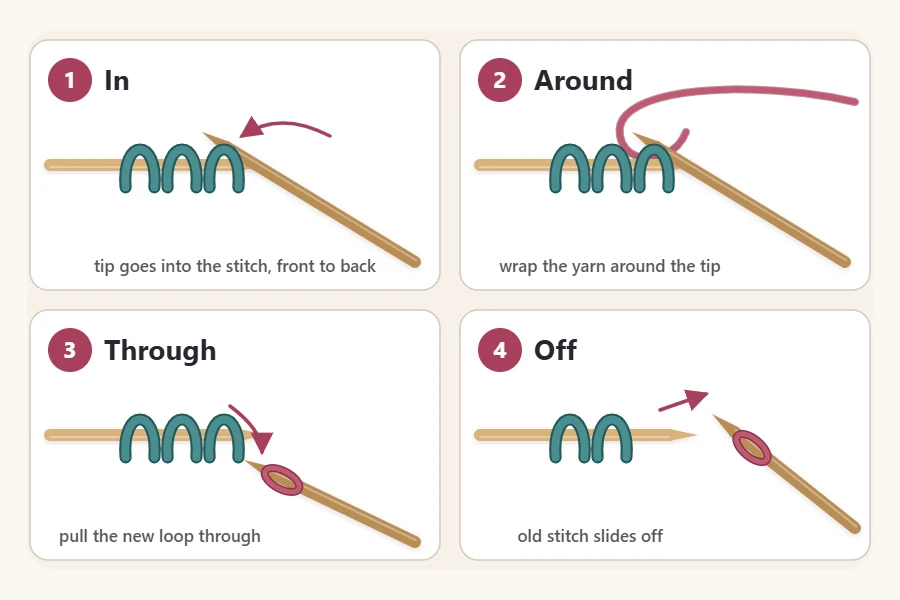
That is one knit stitch. Repeat the four motions on the next stitch, and the next, until every stitch has moved from the left needle to the right needle. You have finished a row.
Turning and starting the next row
To begin the next row, turn the work around: move the full needle to your left hand and take the empty needle in your right. The working yarn now hangs from the first stitch you are about to knit.
Watch out
Before the first stitch of each row, check that the yarn hangs straight down and to the back. If it is pulled up and over the needle, the first stitch looks like two loops, and knitting both adds an extra stitch.
Knit across again. Then turn, and knit again. There is nothing more to it.
What you are making: garter stitch
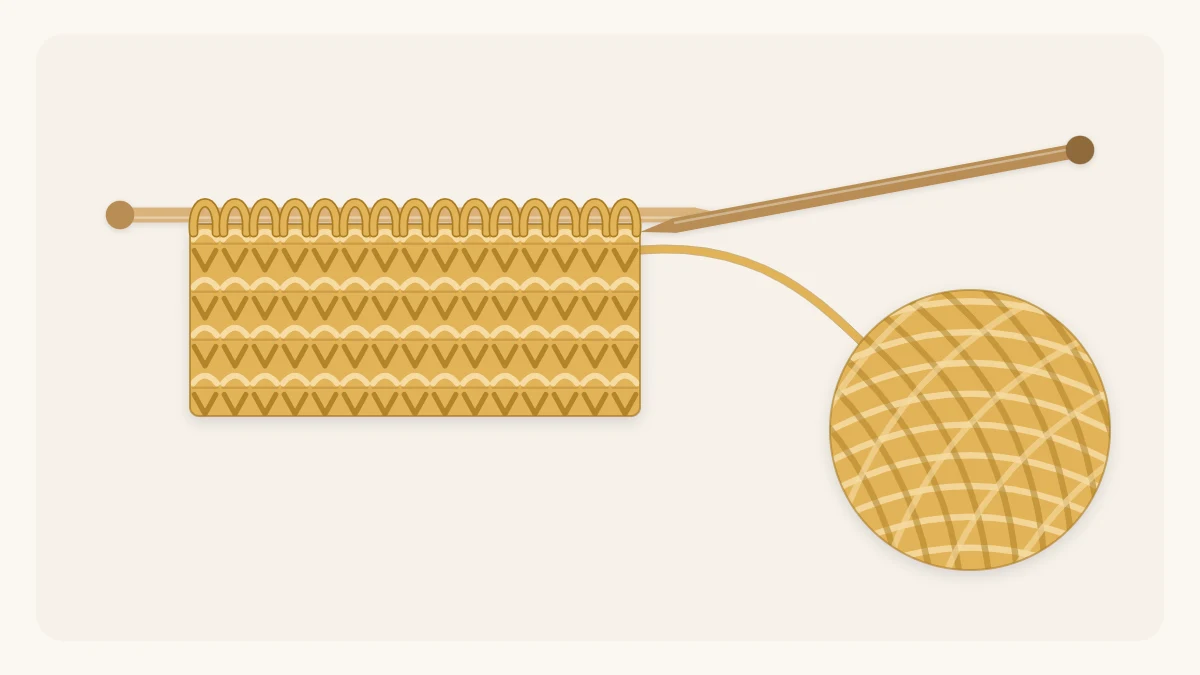
When you work flat and knit every row, the fabric is called garter stitch. It has horizontal ridges on both sides, and two rows of knitting make one ridge. To count rows, count the ridges on one side and double the number.
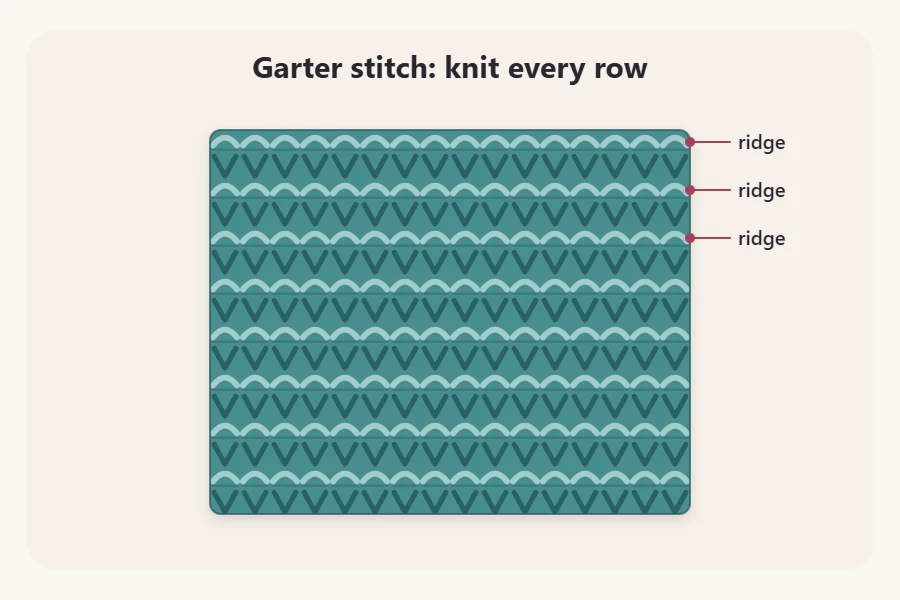
Garter stitch lies flat, stretches comfortably and looks the same on both sides, which is why so many first projects use it. There is more about it in the guide to garter stitch.
Fixing common knit stitch problems
The stitches are too tight
If you can barely get the needle in, you are probably forming each stitch on the narrow tip. After the “through” step, let the new loop slide onto the full thickness of the right needle before you move on, and avoid tugging the yarn after every stitch.
The stitch count keeps growing
Extra stitches usually come from the first stitch of a row being pulled over the needle, or from the yarn slipping over the right needle between stitches. Count your stitches every few rows so that you notice early.
A stitch fell off the needle
Do not pull on the fabric. Catch the loose loop with a needle tip or a safety pin, then follow the steps in how to fix a dropped stitch.
The needle splits the yarn
If the tip goes through the strand instead of under it, back the needle out and insert it again. A split stitch looks thin and frayed in the finished fabric.
A simple practice plan
- Knit 20 rows on your 20 stitches, which makes 10 ridges.
- Count the stitches at the end of every few rows. The answer should always be 20.
- Stop mid-row at least once. When you pick the work up again, the needle with the working yarn attached goes in your right hand.
- Expect uneven stitches at first. They even out with practice.
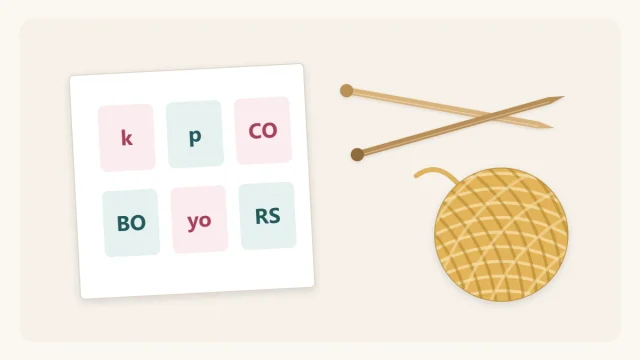
In written patterns, the knit stitch is shortened to k, so “k20” means knit 20 stitches.
Where to go next
Once your rows feel steady, you can put the knit stitch straight to work in the easy garter stitch scarf pattern, which is knit every row from the first stitch to the last. When you want smooth fabric and ribbing as well, learn the purl stitch, the knit stitch’s other half.
Frequently asked questions
Where should the yarn be for a knit stitch?
The working yarn stays at the back of the work, on the side away from you, for every knit stitch. If it drifts to the front and you knit anyway, the strand crosses over the needle and creates an extra loop. Check the yarn position at the start of each row in particular.
Which way do I wrap the yarn for a knit stitch?
Wrap counterclockwise around the tip of the right needle, so the yarn passes behind that needle and comes forward between the two needles. Wrapping the other way still makes a loop, but the stitch sits backward on the needle and looks twisted when you work it on the following row.
Why do I have more stitches than I cast on?
The usual cause is the first stitch of a row. When the yarn is pulled up and over the needle, that stitch shows two strands and is easy to knit twice. An accidental wrap of yarn over the needle between stitches does the same thing. Counting every few rows catches it early.