How to Read a Knitting Pattern: A Beginner’s Guide
Learn how a knitting pattern is laid out and how to decode it: materials, gauge, abbreviations, asterisks and parentheses, with a row from a real beginner pattern worked through in plain words.
Figuring out how to read a knitting pattern can feel like decoding a secret message. A line such as “*k2, p2; rep from * to end” looks nothing like ordinary English. It is a compact shorthand, though, and it follows a small set of rules.
Once you know where each piece of information lives on the page and what the punctuation means, most beginner patterns turn out to be short lists of instructions you already know how to carry out.
The parts of a pattern
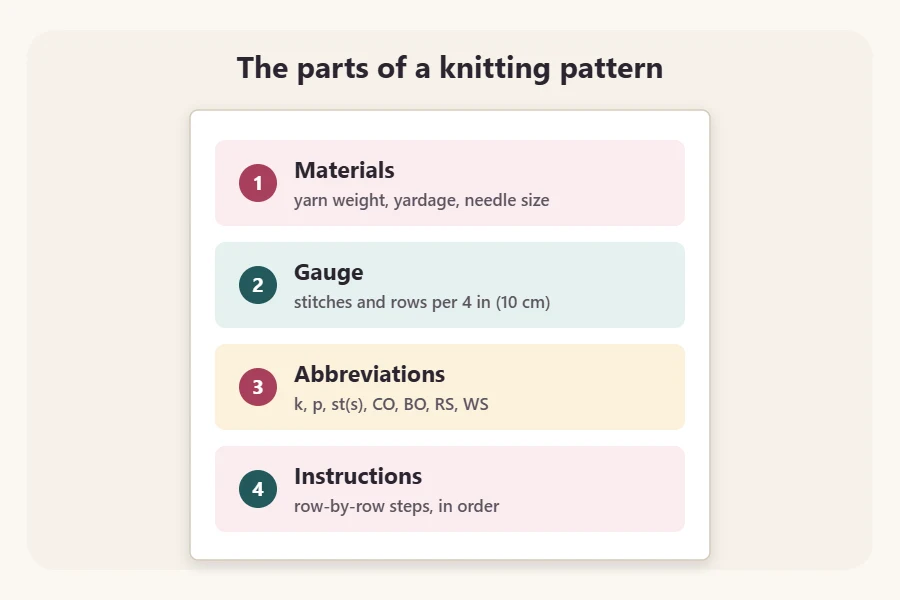
Almost every pattern is laid out in the same order. Before the first row there is a block of information that tells you what to buy and what to expect.
- Finished measurements or sizes: how big the piece will be.
- Materials: the yarn, needles and small tools required.
- Gauge: how many stitches and rows fit in a set measurement.
- Abbreviations: a key to the shorthand used.
- Instructions: the row-by-row directions, often followed by finishing steps.
Read the whole pattern once before you buy anything or cast on. It takes a few minutes and prevents most surprises.
Materials: yarn, needles and notions
The materials list names a yarn by weight and amount, for example “worsted weight (medium, #4), about 200 yards.” The number refers to the standard yarn weight system, which runs from 1 (super fine) to 6 (super bulky) for the yarns beginners usually meet. Match the weight, then make sure you have enough yardage.
Needles are given by size, such as US 8 (5 mm), and sometimes by type and length. Notions are the small extras, such as a tapestry needle or stitch markers. If yarn labels are new to you, the guide to the best yarn for beginner knitters shows where to find the weight and yardage.
Gauge: the line beginners skip
Gauge is the number of stitches and rows in 4 inches (10 cm) of fabric. A typical line reads “18 sts and 24 rows = 4 in in stockinette stitch.” It tells you how tightly the designer knit, and so how large each stitch needs to be for the piece to come out at the stated size.
You check it by knitting a small test square. If you get too many stitches in 4 inches, your stitches are too small, so go up a needle size. If you get too few, go down a size. The steps are in how to knit and measure a gauge swatch.
Gauge matters most for anything that has to fit. For a scarf or a dishcloth, being slightly off only changes the size a little and how much yarn you use.
Abbreviations: the pattern’s shorthand
Patterns shorten common words to save space. These are the ones you will meet first.
| Abbreviation | Meaning |
|---|---|
| k | knit |
| p | purl |
| st(s) | stitch(es) |
| CO | cast on |
| BO | bind off |
| RS | right side, the side meant to show |
| WS | wrong side, the inside or back |
| rep | repeat |
A number after a stitch tells you how many to work: “k3” means knit 3 stitches. For everything else, see knitting abbreviations explained, or the Craft Yarn Council’s master list of knitting abbreviations.
How to read a row
Row instructions are read from left to right, one step at a time. The punctuation does real work.
- Commas separate one step from the next.
- Asterisks mark a group of stitches to repeat. “Rep from *” means go back to the asterisk and work that group again.
- Parentheses or brackets group stitches that are worked a set number of times, as in “(k1, p1) 3 times.”
- A stitch count at the end of a row, such as “(24 sts),” tells you how many stitches you should have when the row is done.
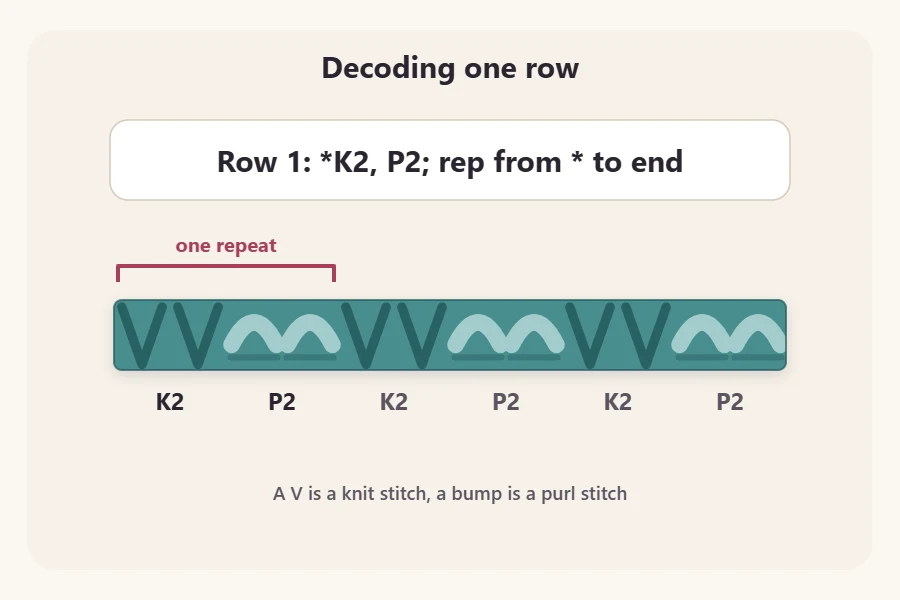
Take “Row 1: *K2, P2; rep from * to end.” You knit 2, purl 2, then return to the asterisk and do it again, over and over, until you run out of stitches.
A worked example
Here is the first row of the site’s easy knit headband pattern, which begins “CO 18 sts”:
Row 1 (RS): *k2, p2; rep from * to last 2 sts, k2.
In plain words: this is a right-side row. Knit 2 and purl 2, and keep repeating those four stitches until only 2 stitches remain on the left needle. Knit those last 2. Four repeats use 16 stitches, and the final k2 brings the total to 18, which matches the cast-on. Doing that arithmetic is a good way to check that you have understood a row.
Phrases that trip beginners up
- “Work even” means keep going in the stitch pattern without adding or removing stitches.
- “Repeat these 2 rows until piece measures…” means measure the knitting laid flat and unstretched, from the cast-on edge.
- “Ending after a WS row” means the last row you finish is a wrong-side row, so the next one starts on the right side.
- “BO in pattern” means knit the knit stitches and purl the purl stitches as you bind off.
Tip
If a line still makes no sense, write it out in full words on paper. Shorthand that looks confusing on the page is usually simple once it is spelled out.
Before you cast on: a quick checklist
- Read the pattern from start to finish.
- Look up every abbreviation you do not recognize.
- If there are several sizes, circle the numbers for yours.
- Check your gauge if the fit matters.
- Keep track of your place by ticking off each row with a pencil or using a row counter.
The best practice is a short, simple pattern. The ideas in first knitting projects are listed from easiest upward.
Frequently asked questions
What do the asterisks mean in a knitting pattern?
An asterisk marks the start of a group of stitches that you work more than once. When the instruction says to repeat from the asterisk, you return to that point and work the same group again, continuing until you reach the end of the row or the number of stitches the pattern names.
Do I have to knit a gauge swatch for every pattern?
It is strongly recommended for anything that needs to fit, such as a hat or a sweater, because small differences in stitch size add up across a whole piece. For flat items like scarves and dishcloths, gauge is less critical, although it still affects the finished size and how much yarn you use.
What does RS and WS mean in a pattern?
RS stands for right side, the face of the fabric that is meant to be seen when the item is finished. WS stands for wrong side, the inside or back. Patterns label rows this way so you know which face is toward you while you work that row.