Garter Stitch: How to Knit the Easiest Stitch Pattern
Learn how to knit garter stitch flat, why knitting every row makes ridges on both sides, how to count rows by ridges, and how to fix the most common beginner problems.
Tutorial at a glance
Materials
- Smooth, light-colored worsted-weight yarn
- US 8 (5 mm) wood or bamboo needles
- Scissors
- Removable stitch marker
Garter stitch is the first fabric almost every knitter makes, because it asks for only one move: the knit stitch, on every stitch of every row. There is nothing to keep track of and no second stitch to learn.
The result is a springy, ridged fabric that lies flat and looks the same on both sides. Those qualities make it useful long after your first swatch, for scarves, blankets and the borders of other stitch patterns.
What garter stitch looks like
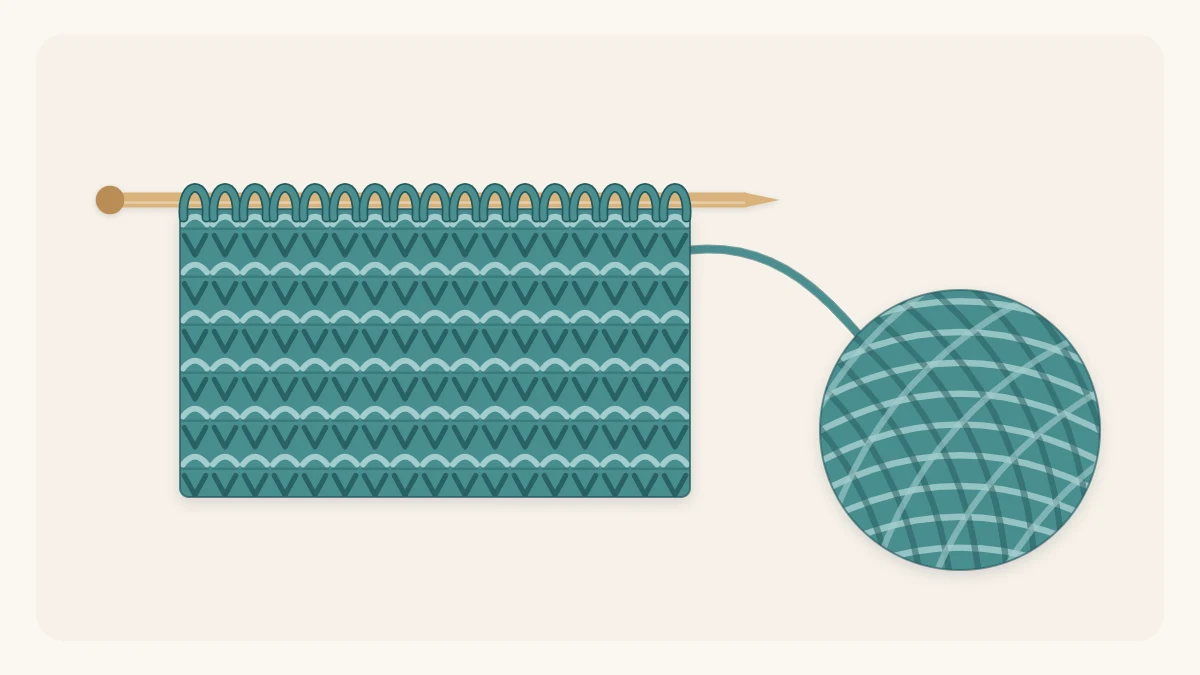
Garter fabric is made of horizontal ridges with narrow valleys between them. Each ridge is a row of small bumps, and each valley hides a row of smooth V shapes.
The reason is simple. Knit and purl are two faces of the same stitch: a knit stitch seen from behind is a purl bump. When you turn your work at the end of a row, you are looking at the back of the row you just made. Knitting every row therefore stacks rows of Vs and rows of bumps alternately on each face, which is why the fabric is reversible.
What you need to practice
- A smooth, light-colored yarn in worsted weight (medium, #4), so you can see each stitch clearly
- US 8 (5 mm) needles, ideally wood or bamboo, which grip the stitches a little
- Scissors and a removable stitch marker or safety pin
How to knit garter stitch flat
Written as a pattern, garter stitch is about as short as instructions get: “CO any number of sts. Every row: k all sts.” CO means cast on, sts means stitches and k means knit. Here is the same thing step by step.
- Cast on 20 stitches.
- Hold the needle with the stitches in your left hand and the empty needle in your right. The working yarn, the strand that runs to the ball, hangs at the back of the work.
- Work the knit stitch into every stitch: in, around, through, off.
- When the left needle is empty, turn the work. Swap the needles so the full one is in your left hand again.
- Knit every stitch of the next row in exactly the same way.
- Repeat until the piece is as long as you want, then bind off loosely.
That is the whole stitch pattern. Any number of stitches works, so you never have to count a repeat.
Counting rows: two rows make one ridge
A ridge only shows on the side that was facing away from you when you knit that row. So one row puts a ridge on the back, the next puts a ridge on the front, and it takes two rows to add one ridge to either face.
To count rows, count the ridges on one side and double the number. Ten ridges means 20 rows. Do not count ridges on both sides and add them together, or you will count every row twice.

Tip
Because both sides look alike, clip a removable marker to the side facing you on Row 1. Whenever the marker faces you, you are about to knit an odd-numbered row.
Why garter stitch lies flat
Each face of garter fabric carries the same mix of knit rows and purl bumps, so neither side pulls harder than the other. The fabric stays flat at every edge with no border and very little fuss.
Compare that with stockinette stitch, where all the smooth knit faces sit on one side. That imbalance makes stockinette roll at the edges, and a few stitches of garter along each side is one of the classic ways to tame it.

Garter has a few other habits worth knowing:
- It is stretchy, especially lengthwise, and it springs back.
- It is thicker than stockinette in the same yarn, which makes it warm.
- The rows sit close together, so a ridge is roughly as tall as one stitch is wide. A piece grows more slowly in length than you might expect.
Garter stitch in the round
“Knit every row” only produces garter stitch when you work flat, turning at the end of each row. On a circular needle joined into a tube you never turn, so the same side always faces you. To get ridges there, you knit one round and purl the next. That is something to remember later; every beginner project on this site is worked flat.
Common garter stitch problems
The piece is getting wider
The usual cause is at the start of a row. If the working yarn is pulled up and over the needle before the first stitch, that stitch is stretched so both of its legs sit on the needle and look like two stitches. Let the yarn hang down at the back before you begin, and count your stitches every few rows.
A smooth stripe or a gap in the middle
This tends to happen after you set the work down mid-row and start again in the wrong direction. When you pick it up, the working yarn should hang from the last stitch on the right-hand needle.
Wobbly edges
The first stitch of a row is often looser than the rest. Give the yarn a gentle tug after working it, without strangling the stitch. Edges even out with practice, and garter is forgiving about it.
What to make with garter stitch
A long rectangle is all you need for a real project. The easy garter stitch scarf pattern uses about 200 to 220 yards of worsted-weight yarn on US 8 (5 mm) needles: cast on 28 stitches and knit every row until the scarf is about 60 inches (152 cm) long, then bind off loosely.
The same stitch in bulky yarn makes a quick cowl or a lap blanket, and a few rows of it will frame a dishcloth. Once knitting every row feels automatic, you are ready to add the purl stitch.
Frequently asked questions
Is garter stitch the same as the knit stitch?
Not quite. The knit stitch is a single movement that makes one new loop. Garter stitch is the fabric you get when you use that movement on every stitch of every row while working flat. One is the building block, and the other is a stitch pattern made from it.
Why does my garter stitch have more stitches than I cast on?
Most often the first stitch of a row has been stretched over the needle so its two legs look like two stitches, and both get knitted. An accidental wrap of yarn over the needle does the same. Keep the yarn hanging at the back before the first stitch and count regularly.
Does garter stitch use more yarn than stockinette?
For the same size of fabric it generally does, because garter rows pack closely together and you need more of them to reach a given length. That density is also what makes garter thick and warm. Buy the yardage a pattern lists rather than estimating from a stockinette project.