Seed Stitch: How to Knit This Textured Beginner Pattern
Learn how to knit seed stitch on odd and even stitch counts, how to read your stitches so you always know what comes next, and how seed stitch differs from 1x1 ribbing.
Tutorial at a glance
Materials
- Smooth, light-colored worsted-weight yarn
- US 8 (5 mm) needles
- Scissors
- Tapestry needle for the ends
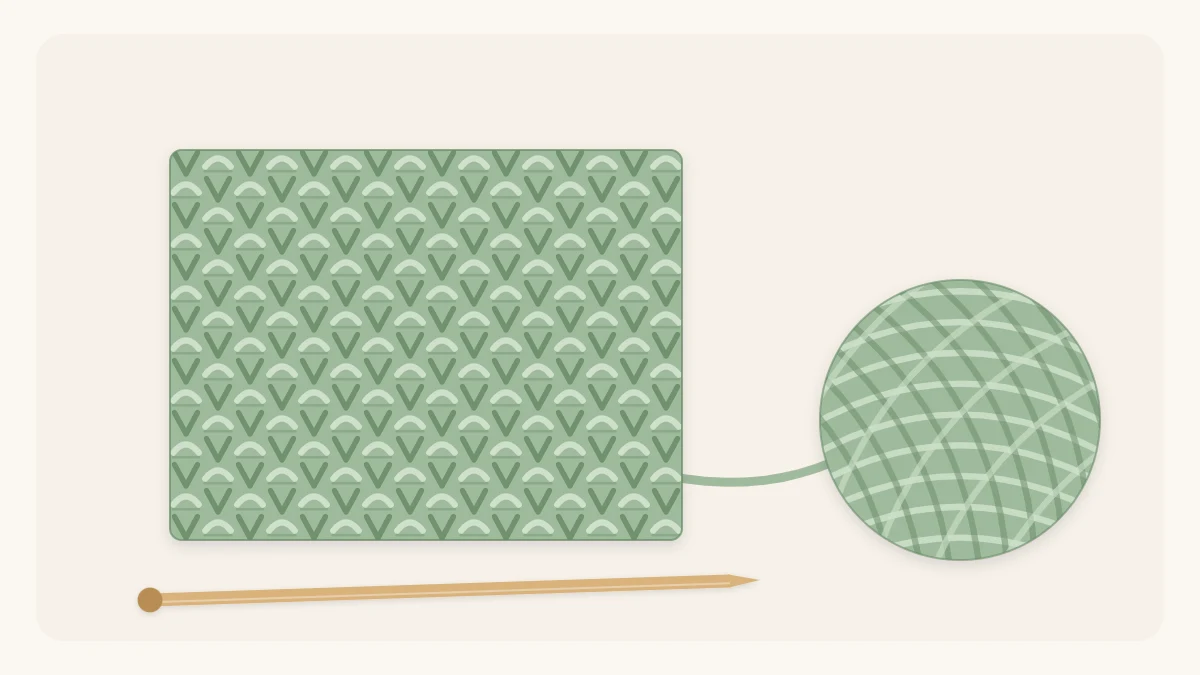
Seed stitch is a fabric dotted all over with small raised bumps, like seeds scattered on soil. It looks intricate, but it uses only the knit stitch and the purl stitch, one after the other.
If you can work a row of knit 1, purl 1, you already have the hand movements. The only difference from ribbing is where each stitch lands on the following row.
What seed stitch is
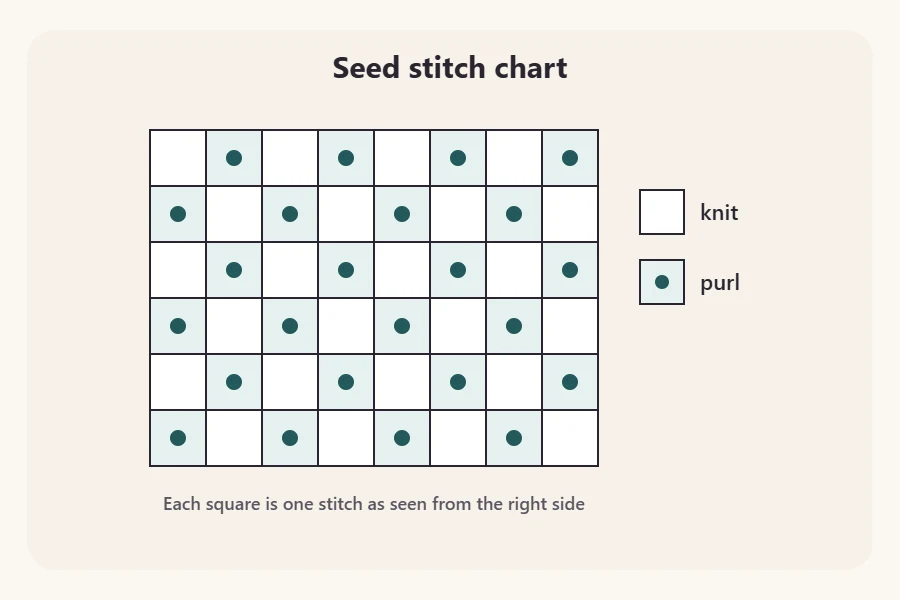
In seed stitch you alternate one knit stitch and one purl stitch across the row, then offset them on the next row so that every knit sits above a purl and every purl sits above a knit. The result is a checkerboard of tiny Vs and bumps.
The fabric has some very useful properties:
- It lies flat and does not curl at the edges.
- It is reversible, with the same pebbly texture on both sides.
- It is firmer and less stretchy than ribbing, and it does not pull in.
- Its texture hides slightly uneven stitches better than a smooth fabric does.
UK patterns call this same stitch moss stitch, which is worth knowing if you follow a pattern written there.
What you need
For a practice swatch, use a smooth, light-colored worsted-weight yarn (medium, #4) and US 8 (5 mm) needles. Textured stitches are hard to read in dark or fuzzy yarn.
The instructions below use a few standard abbreviations: k1 means knit one stitch, p1 means purl one stitch, and “rep from *” means repeat everything after the asterisk.
Seed stitch on an odd number of stitches
This is the easiest version, because every row is identical. Cast on an odd number, such as 21.
Every row: k1, *p1, k1; rep from * to end.
- With the yarn in back, knit 1.
- Bring the yarn forward between the needle tips and purl 1.
- Take the yarn back between the needle tips and knit 1.
- Repeat steps 2 and 3 to the end of the row. The last stitch is a knit.
- Turn and work the next row in exactly the same way.
Why does the same row produce an offset? Each row begins and ends with a knit. When you turn the work, the knit stitch you just made at the end is now first in line, and from the back it shows as a purl bump. Knitting it puts a V on top of a bump, and the rest of the row follows.
Seed stitch on an even number of stitches
With an even number, such as 20, you need two rows that mirror each other.
- Row 1: *k1, p1; rep from * to end.
- Row 2: *p1, k1; rep from * to end.
Repeat these two rows. If you lose track of which row you are on, the fabric will tell you, as the next section explains.
Reading your stitches
The rule for seed stitch is the opposite of the rule for ribbing: purl the knits and knit the purls.
Before each stitch, look at the one waiting on the left needle.
- If it has a smooth V below it, it was a knit as it faces you. Purl it.
- If it has a bump wrapped around its base, it is a purl as it faces you. Knit it.
Once you can see this, you no longer need to remember whether you are on Row 1 or Row 2, and you can work seed stitch over any number of stitches.
Tip
Check the first two stitches of every row before you settle into the rhythm. If those are right, the rest of the row follows the same alternation.
Seed stitch vs. ribbing
Seed stitch and 1×1 ribbing use the same sequence of stitches within a row. What changes is how the rows stack. In ribbing, knits sit on knits and purls on purls, making vertical columns that stretch. In seed stitch, each row is shifted by one stitch, which breaks up the columns into dots.
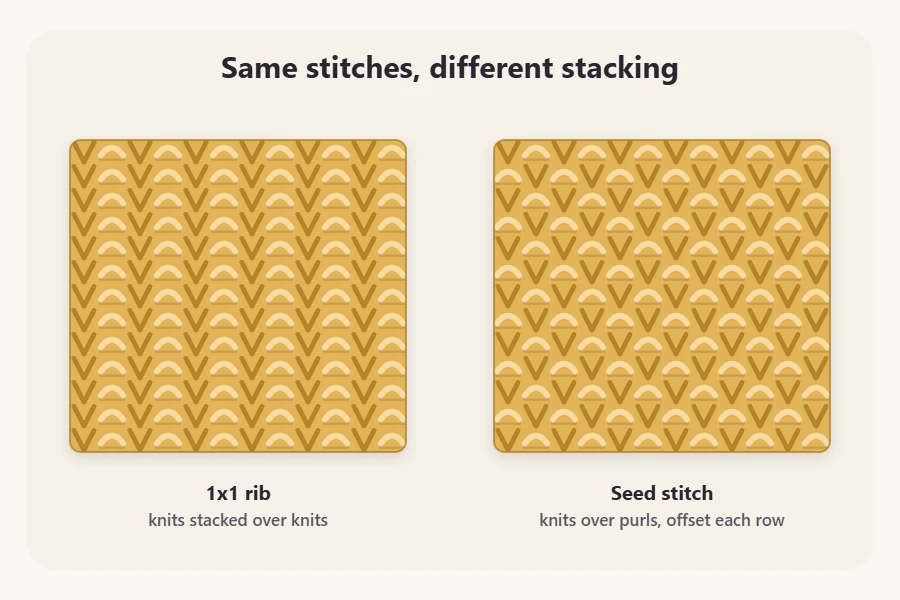
This explains the most common beginner slip. If columns start to appear in your seed stitch, you have repeated a row instead of offsetting it. On an even number of stitches, that means you worked Row 1 twice in a row.
Common seed stitch problems
Extra stitches and small holes
You move the yarn between front and back after every single stitch, so there are plenty of chances to carry it over the needle by mistake. That makes an accidental yarn over, which is an extra loop that becomes an extra stitch with a hole beneath it. Always pass the yarn between the needle tips, and count your stitches every few rows.
One stitch out of place
A single V where a bump should be stands out in this fabric. If you spot it within the same row, un-knit back to it one stitch at a time and rework it. If it is several rows down, decide whether it will bother you: on a practice swatch, it is a useful reminder to read your stitches.
It feels slow
It is slower than plain knitting, because of all the yarn movement. Speed comes as your hands learn to flick the yarn forward and back with a small motion.
Where to use seed stitch
Because it lies flat, seed stitch makes a good border for stockinette stitch, which otherwise curls. A few stitches of seed at each side and a few rows top and bottom will frame a smooth center neatly.
It also works well as an all-over fabric for scarves, dishcloths and cowls. The simple knit cowl on this site is written in garter stitch with seed stitch as an optional variation. It uses about 120 yards of bulky yarn (#5) on US 10.5 (6.5 mm) needles and a cast-on of 32 stitches. That is an even number, so you would use the two-row version above.
Frequently asked questions
Is seed stitch the same as moss stitch?
It depends on where the pattern comes from. In UK patterns, moss stitch usually means the one-row offset described here, which US patterns call seed stitch. In US patterns, moss stitch often refers to a related texture that shifts every two rows. Check the row instructions rather than relying on the name.
Why does my seed stitch look like ribbing?
Your knits are landing on knits and your purls on purls, so columns are forming. On an even number of stitches this happens when the same row is worked twice. Look at each stitch before you work it and do the opposite: purl the smooth Vs and knit the bumps.
Does seed stitch curl like stockinette?
No. Knit and purl stitches are spread evenly across both faces of the fabric, so neither side pulls harder than the other and the edges stay flat. That balance is why seed stitch is often used for borders, collars and button bands as well as for whole projects.