How to Weave In Ends and Join a New Ball of Yarn
Learn how to hide yarn tails so they stay put through wear and washing, on both stockinette and garter stitch, and how to join a new ball of yarn at the start of a row.
Tutorial at a glance
Materials
- Tapestry needle with a blunt tip
- Small scissors
- Finished knitting with tails about 6 inches long
- New ball of yarn for practicing a join
Every piece of knitting finishes with at least two loose tails, one from the cast-on and one from the bind-off, and each new ball adds two more. Learning how to weave in ends in knitting is what turns a swatch with strings hanging off it into something you can use, wash and give away.
The job takes a blunt needle and a few minutes per tail. It is also a good moment to learn the partner skill: joining a new ball of yarn so that the ends land somewhere easy to hide.
What you need
- A tapestry needle (also called a yarn needle) with a blunt tip and an eye large enough for your yarn.
- Small scissors.
- Tails at least 6 inches (15 cm) long. Shorter tails are hard to thread and tend to work loose.
A tapestry needle is one of the handful of small tools worth buying early. A sharp sewing needle is a poor substitute, because it pierces the yarn when you want it to slide between the strands.
Three rules for a secure end
Whatever stitch pattern you are working in, the same three ideas apply.
- Work on the wrong side (WS). That is the side that faces inward or is seen least. On reversible fabric, pick one side and use it for every tail.
- Cover about 2 inches (5 cm). Much less than that and the tail can wriggle out with wear.
- Change direction once. Weave one way for about an inch, then turn and head back another way. A tail that travels in a single straight line can slide out the way it went in. A turn locks it.
Keep the tail as relaxed as the fabric around it. After every few stitches, give the knitting a gentle stretch. If the fabric puckers, the tail is too tight, so loosen it before you go on.
Weaving in ends on stockinette
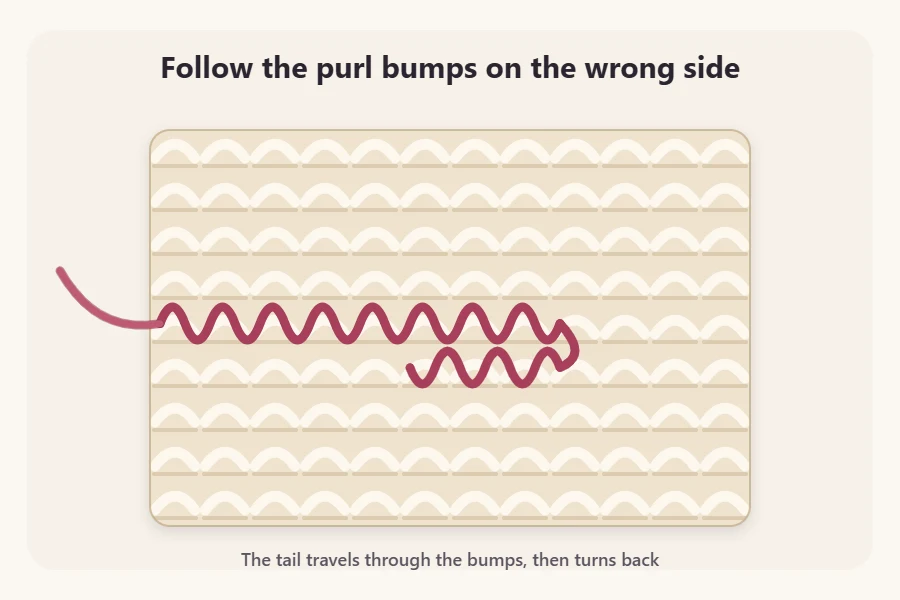
The wrong side of stockinette stitch is covered in purl bumps, and those bumps are your hiding place.
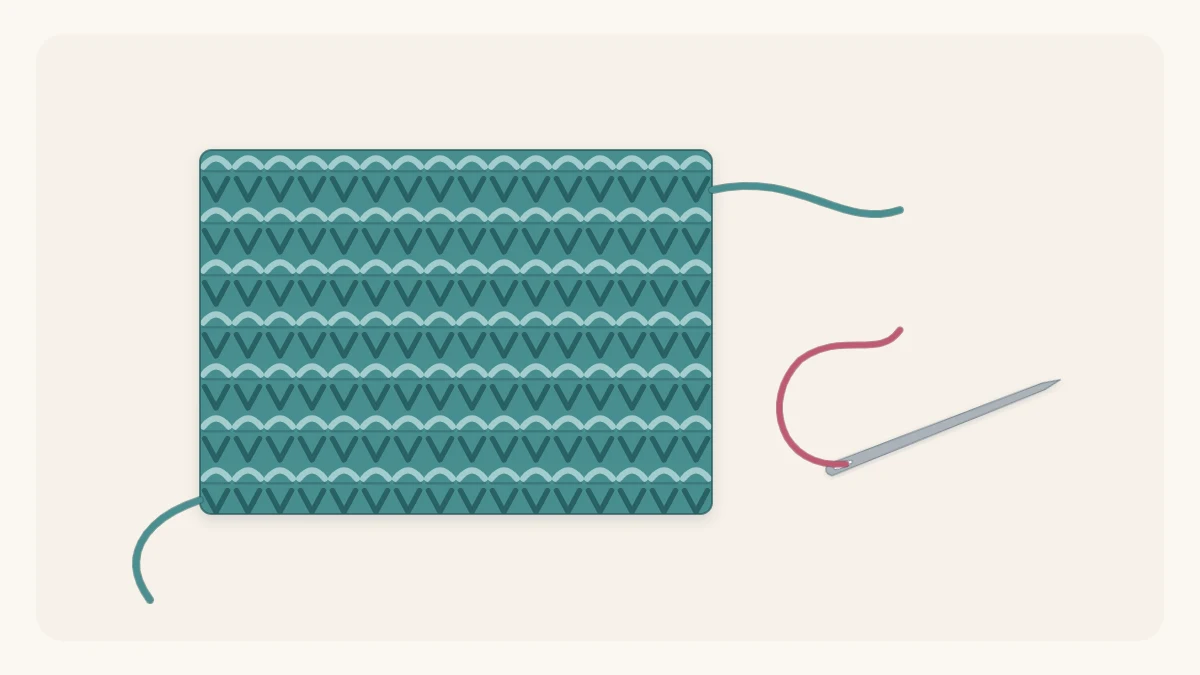
- Thread the tail onto the tapestry needle and turn the work so the WS faces you.
- Slide the needle under a purl bump next to the spot where the tail comes out. Go under the bump only, not through to the front of the fabric.
- Move diagonally. Catch one bump in the next row up and one stitch over, then the next, for five or six bumps. A diagonal path stretches with the fabric better than a straight one.
- Turn and work back along a second diagonal for another four or five bumps, so the path makes a shallow V.
- Flip to the right side (RS) and check that the tail does not show between the stitches.
Tip
With smooth, slippery yarn such as cotton, let the needle pierce the strand of a purl bump now and then. Splitting the yarn adds grip and helps the tail stay put.
Weaving in ends on garter stitch
Garter stitch looks the same on both sides, so choose a wrong side and stick with it. The ridges do the hiding here.
- Slide the needle under the bumps of one ridge, working along the row for about an inch.
- Drop down to the neighboring ridge and work back the other way for another inch.
- Stretch the fabric gently along its width so the tail settles to the same length as the row.
At the cast-on and bind-off corners, take the tail into the first ridge inside the edge, not along the edge itself. The edge stays stretchy and the tail is less visible.
How to join a new ball of yarn
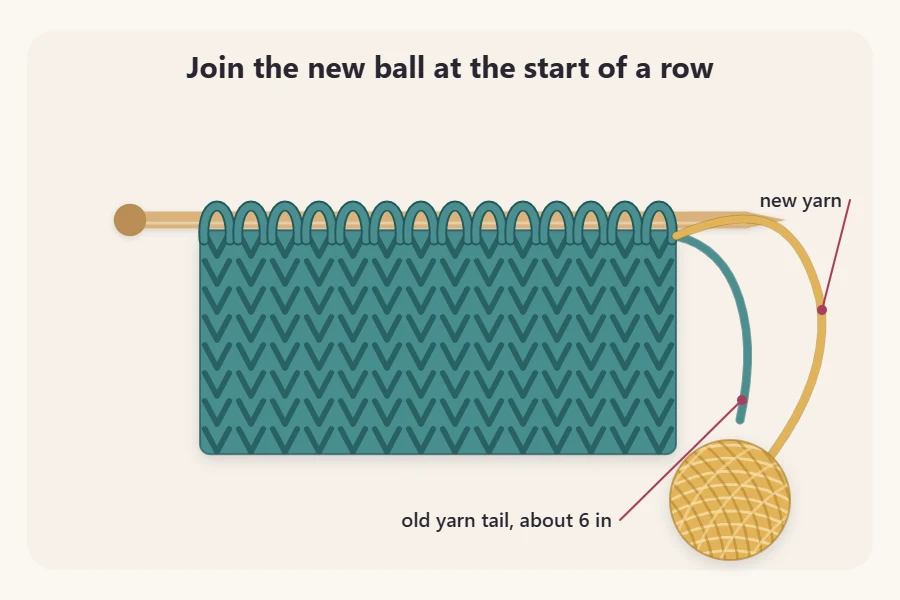
Where you join decides how easy the ends are to hide. The start of a row is the best place, because both tails sit at the edge and can be woven into the edge stitches or a seam.
- Stop at the end of a row while you still have at least 6 inches of the old yarn left.
- Turn the work. Leave the old yarn hanging and lay the new yarn over your finger with a 6-inch tail.
- Knit the first stitch with the new yarn. It will feel loose, which is normal.
- Work two or three more stitches, then tug both tails gently to snug up the edge.
- Carry on with the row. Weave in both tails when the piece is finished.
How do you know whether the old yarn will last one more row? A row uses roughly three times the width of your knitting. If the remaining yarn is shorter than about four widths, join the new ball now.
Joining in the middle of a row
Sometimes you cannot avoid it, for example when you meet a knot in the ball. Drop the old yarn, start knitting with the new one, and leave two 6-inch tails on the wrong side. When you weave them in, cross the tails over each other first to close the small gap, then take each one in the opposite direction.
When to trim the tails
Do not cut right after weaving. Knitting shifts the first time it is washed or blocked, and a tail trimmed flush can pop through to the right side. Leave about an inch hanging, wash or block the piece, let it dry, then snip each tail close to the fabric.
Watch out
Hold the scissors parallel to the fabric and cut only the tail. A snipped stitch will unravel into a hole.
Fixing common problems
- The fabric puckers. The tail was pulled too tight. Pick it out with the needle tip and weave again with more slack.
- The tail shows on the right side. The needle went too deep. Catch only the surface of each bump. A dark tail in light fabric shows most, so weave it into its own color where you can.
- The tail keeps working out. The path was too short or had no turn. Weave a full 2 inches and change direction.
- The tail is too short to thread. Push the empty needle along the path first, leaving the eye next to the tail. Then thread the tail and pull the needle through.
A simple project such as the garter stitch scarf gives you several tails to practice on, from the cast-on to the bind-off.
Frequently asked questions
Should I tie a knot when I join a new ball of yarn?
A permanent knot is not needed and can leave a hard lump that works its way to the front. If the loose first stitch bothers you, tie the two tails in a single loose half knot while you knit, then undo it before weaving each tail in. The weaving, not a knot, is what holds the join.
How long should a yarn tail be for weaving in?
Leave about 6 inches. That gives you enough length to thread a tapestry needle comfortably, weave through roughly 2 inches of fabric with one change of direction, and still have a little left to trim after washing. Tails shorter than about 4 inches are awkward to handle and more likely to slip out.
Can I weave in ends as I go instead of at the finish?
Yes, you can stop and weave tails with a tapestry needle whenever you like, and many knitters do this on big projects so the job does not pile up. Just leave the tails untrimmed until the piece has been washed or blocked, because the fabric shifts and a short tail can poke through.