How to Fix a Dropped Stitch in Knitting
A dropped stitch is easy to rescue. Learn how to secure the loop, then work it back up the ladder with a crochet hook in stockinette, purl and garter stitch.

Tutorial at a glance
Materials
- Crochet hook close to your needle size or slightly smaller
- Locking stitch marker or safety pin
- Your knitting on the needles
- Tapestry needle and spare yarn for a finished piece
A stitch slips off the needle, and a few rows later there is a hole with a ladder running down from it. It looks alarming, but knowing how to fix a dropped stitch is one of the most useful repair skills in knitting, and it takes only a crochet hook and a calm minute.
Nothing is ruined. Knitted fabric is a set of loops pulled through loops, and a dropped stitch is one column of those loops that has come undone. You rebuild it one loop at a time.
First, secure the loop
The moment you spot a dropped stitch, stop knitting and stop stretching the fabric. Every tug lets the loop run down another row.
Slip a locking stitch marker or a safety pin through the loose loop and close it. The stitch cannot travel any further now, and you can take your time. Both the marker and the hook used below are standard knitting notions worth keeping in your project bag.
What a dropped stitch looks like
Look closely at the damage and you will see two things:
- The live loop at the bottom. This is the stitch that escaped.
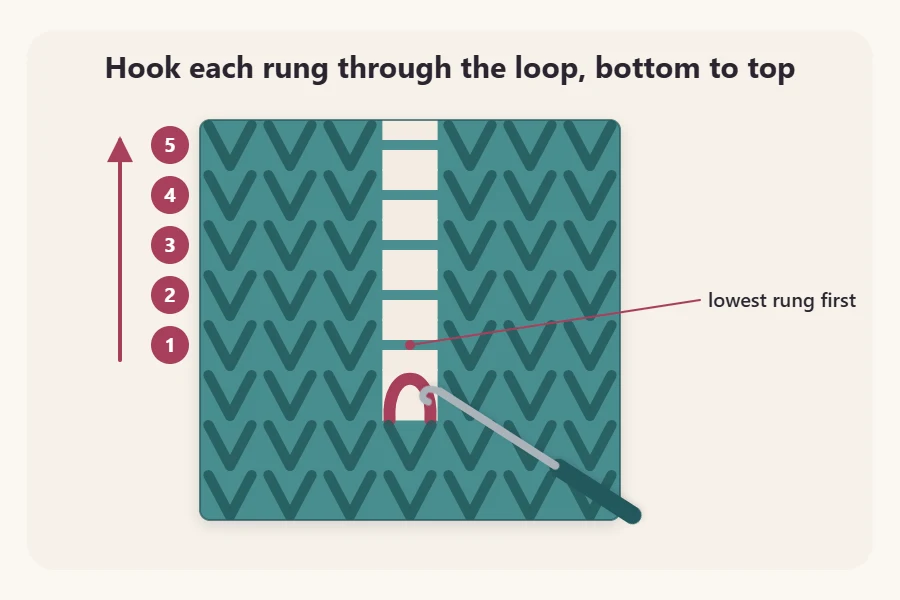
- The ladder above it: a stack of loose horizontal strands, or rungs. Each rung is the yarn from one row that should have been pulled through the loop below.
Count the rungs. That number is how many rows the stitch has dropped, and how many times you will repeat the fix.

How to fix a dropped stitch on the knit side
This method is for stockinette stitch with the smooth right side (RS) facing you. Use a crochet hook close to your needle size or a little smaller.
- Work along the row until you are directly above the ladder, so the dropped column sits between your two needle tips.
- Remove the marker and insert the hook into the live loop from front to back.
- Check that the lowest rung lies behind the loop. Catch that rung with the hook.
- Pull the rung through the loop toward you. The old loop drops off the hook and you have rebuilt one stitch.
- Repeat with the next rung up. Always take the rungs in order from the bottom. Skipping one leaves a tight, puckered spot.
- When no rungs are left, place the loop on the left needle with its right leg in front of the needle, then knit it as usual.
Tip
The rebuilt column may look a little looser or tighter than its neighbors. Give the fabric a gentle stretch in both directions. Most of the unevenness settles then, and more disappears in the first wash.
Fixing a dropped purl stitch
On the bumpy wrong side (WS) of stockinette you have two choices.
The easy one is to turn the work around so the smooth side faces you and use the steps above. A purl is simply a knit stitch seen from behind, so repairing it from the knit side gives exactly the right result.
If you would rather not turn the work, insert the hook into the loop from back to front, make sure the rung sits in front of the loop, and pull the rung through to the back. Repeat for every rung.
Fixing a dropped stitch in garter stitch
Garter stitch alternates between a smooth row and a ridge row on each face, so the repair alternates too.
- Look at the stitches on either side of the ladder, level with the lowest rung. If they show smooth Vs, insert the hook from the front and pull the rung, which lies behind the loop, through toward you.
- If the neighbors show a ridge of bumps, take the hook out, reinsert it from the back with the rung in front of the loop, and pull the rung through to the back.
- Switch between the two for each rung until you reach the needle.
It is fiddly the first time. Check after every rung that your new stitch matches the row beside it, and undo one rung if it does not.
When the stitch has dropped only one row
For a single rung on a knit row you do not need a hook at all.
- Insert the right needle from front to back through the loose loop and then under the strand behind it.
- With the left needle tip, lift the loop over the strand and off the right needle, just as you would when binding off.
- Slip the new stitch back to the left needle, right leg in front, and knit it.
When you find it many rows later
Sometimes you notice a dropped stitch long after the fact, with rows of firm knitting above it. In that case there is no ladder with spare yarn in it, and hooking the stitch up would make a tight, pulled column.
You have two honest options. You can undo your knitting back to the row where the stitch escaped and re-knit from there. Or, if the piece is already bound off, thread a short length of matching yarn onto a tapestry needle, pass it through the live loop on the wrong side, and weave both ends in securely so the loop can never run.
Watch out
A stitch placed back on the needle with its leading leg behind the needle is twisted. Knit it through the back loop to straighten it, or turn it around before you work it.
How to drop fewer stitches
- Finish the row before you put your knitting down, and push the stitches well back from the needle tips.
- Count your stitches every few rows. A missing stitch is much easier to rescue when it has fallen only a row or two.
- Keep the stitches on the left needle close to the tip, but not crowded onto it.
- Choose wooden or bamboo needles while you learn. They grip the yarn more than metal ones do.
Dropped stitches are only one of the mistakes beginners commonly make, and like the others, they become a small pause in your knitting once you have repaired two or three.
Frequently asked questions
Will a dropped stitch unravel my whole project?
No. A dropped stitch can only run straight down its own column, one row at a time, and it usually stops when the fabric is left alone. It will not spread sideways. Put a locking marker or safety pin through the loop as soon as you see it and the damage stops there.
What size crochet hook do I need to pick up a dropped stitch?
Use a hook about the same size as your knitting needles or slightly smaller. For worsted-weight yarn on US 8 (5 mm) needles, a hook between 4 mm and 5 mm works well. A hook that is too large stretches the stitches, and a very small one tends to split the yarn.
Can I fix a dropped stitch without a crochet hook?
Yes. For a stitch that has fallen one row, the needle tips are enough: lift the loop over the loose strand as if binding off. For a longer ladder you can do the same move repeatedly with a needle tip, although it is slower and fiddlier than using a hook.

