Beginner Knit Blanket: An Easy Garter Stitch Lap Blanket
Knit a garter stitch lap blanket in bulky yarn using only the knit stitch. Covers how much yarn to buy, why a circular needle is used flat, the 104-stitch pattern and how to join new balls.

Tutorial at a glance
Materials
- Roughly 550-650 yd bulky yarn, plus an extra ball
- US 10.5 (6.5 mm) circular needle, 32 in or longer
- 3 stitch markers (optional)
- Large-eye tapestry needle
- Scissors and tape measure
A beginner knit blanket sounds like a big leap, but this one uses exactly the same stitch as a first scarf. It is a lap blanket in garter stitch: cast on, knit every row, bind off. The only real differences are the number of stitches on the needle and the amount of patience involved.
Bulky yarn keeps the project moving and makes a thick, squishy fabric. The finished blanket is about 32 inches (81 cm) wide and 40 inches (102 cm) long, a good size for a lap on the sofa or a throw over the arm of a chair.
Materials
- Bulky (#5) yarn, roughly 550-650 yards, plus one extra ball.
- A US 10.5 (6.5 mm) circular needle, 32 inches or longer.
- Three stitch markers (optional, for counting the cast-on).
- A large-eye tapestry needle, scissors and a tape measure.
To work out how many balls to buy, divide 650 by the number of yards printed on the label and round up, then add one more. The extra ball covers differences in how tightly you knit. Check that every ball has the same dye lot number, because the same color can look visibly different from one dye lot to the next. The yarn guide for beginners shows where to find that number on a label.
Why a circular needle for a flat blanket
A circular needle is two short needle tips joined by a flexible cable. You are not going to knit in a circle. You will work back and forth in rows exactly as you would on straight needles, turning the work at the end of every row and swapping the tips between your hands.
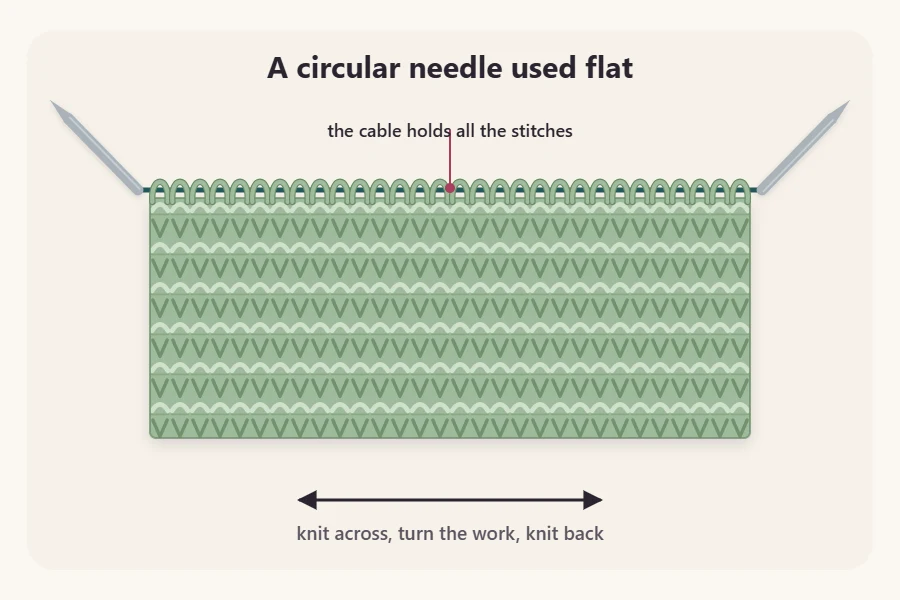
The cable is there for room and comfort. A hundred and four bulky stitches will not fit on a straight needle, and as the blanket grows, the cable lets its weight rest in your lap instead of hanging from your wrists. If circular needles are new to you, the guide to knitting needles for beginners compares the types.
Size and gauge

Gauge is the number of stitches per inch. This blanket works out to roughly 13 stitches over 4 inches (10 cm) in garter stitch. A blanket does not need to fit anyone, so a small difference only changes the finished size a little. A large difference matters more: at 104 stitches, knitting much more loosely could add several inches of width and use up your yarn early.
For that reason a gauge swatch is worth the half hour. Cast on about 20 stitches, knit about 5 inches in garter stitch, lay it flat without stretching and count the stitches across 4 inches. More than 13 means your stitches are small, so go up a needle size. Fewer than 13 means they are large, so go down a size.
Abbreviations
- CO: cast on
- k: knit
- st(s): stitch(es)
- pm: place marker
- sm: slip marker, meaning move it from the left needle tip to the right
- BO: bind off
The blanket pattern
- CO 104 sts. To make counting easier, pm after every 26 sts as you cast on: three markers divide the stitches into four groups of 26.
- Knit every stitch of every row, turning the work at the end of each row. When you reach a marker, sm and carry on.
- Continue until the blanket measures about 40 inches (102 cm) from the cast-on edge, laid flat.
- BO loosely, removing the markers as you come to them.
- Cut the yarn, leaving about a 6-inch tail, pull it through the last loop and weave in all the ends.
Tip
A long-tail cast-on over 104 bulky stitches needs a very long tail. To estimate it, wrap the yarn around the needle 10 times, measure that length, and allow about eleven times as much.
Joining new balls of yarn
You will change balls several times. Join each new one at the start of a row where you can: drop the old yarn, leaving about a 6-inch tail, and begin knitting with the new yarn, leaving another 6-inch tail. The first stitch will feel loose until you have knit a few more, and you can snug it up later.
How do you know whether there is enough yarn for one more row? In garter stitch a row needs a length of yarn roughly three to four times the width of the blanket. If what remains will not stretch across the work at least four times, start the new ball now. Joining mid-row leaves ends in the middle of the fabric, where they are harder to hide.
Keeping a big project on track
- Count now and then. With the markers in place, you only have to check four groups of 26 rather than count to 104.
- Finish the row before you stop. Stitches left in the middle of a row can slide off the tips when the blanket is put away. At the end of a row, push everything onto the cable.
- Measure flat. Lay the blanket on a table or bed. Holding it up lets its own weight stretch it and gives a false reading.
- Count ridges. Two rows make one garter ridge, so ridges are a quick way to track progress.
Watch out
If the blanket is slowly getting wider, you are gaining stitches, usually from an accidental yarn over or from knitting into the strand between two stitches. Catching it within a row or two means very little to undo.
Binding off and finishing
A tight bind-off will pull the top of the blanket in so it is narrower than the bottom. Work the bind-off row with a relaxed hand, or hold a needle one or two sizes larger in your right hand for that row only.
Then deal with the ends. With several balls of yarn there will be a number of tails along the side edges. Thread each onto the tapestry needle and run it through the garter ridges for about 2 inches, change direction once, and trim. Bulky tails are thick, so send each one in a different direction rather than stacking two in the same spot. There are more details in how to weave in ends and join a new ball.
Frequently asked questions
Can I knit a blanket on straight needles?
Not comfortably at this size. Straight needles of 9 or 10 inches cannot hold 104 bulky stitches, and the weight of the growing fabric would hang from your hands. A long circular needle used back and forth holds every stitch on its cable and lets the blanket rest in your lap.
How do I make the blanket bigger or smaller?
Garter stitch works on any number of stitches, so cast on more for a wider blanket or fewer for a narrower one, at roughly 13 stitches for every 4 inches of width. Knit until it is as long as you like. A bigger blanket needs more yarn, so buy accordingly.
Why is my blanket wider at one end than the other?
Either the stitch count changed or one edge is tighter. Count your stitches first: more than 104 means stitches were added along the way. If the count is right, the cast-on or bind-off edge is probably tight and pulling the fabric in, which a looser bind-off prevents.

