Best Yarn for Beginner Knitters: Weight, Fiber and Color
Learn how to choose a first yarn that is easy to knit with: which weight to start on, how wool, acrylic and cotton behave, why color matters, and how to read a yarn label.
The best yarn for beginner knitters is not the prettiest ball on the shelf. It is the one that lets you see every stitch clearly, stays put on the needle, and forgives you when you pull out a row and try again.
Three choices decide that: how thick the yarn is (its weight), what it is made of (its fiber), and what color it is. Get those three right and learning the stitches becomes noticeably easier.
The short answer
For your first project, look for a yarn that is:
- Medium weight, labeled worsted or marked with the number 4
- Smooth, with a round, firmly twisted strand and no fuzz or bumps
- Light or mid-toned, in one solid color
- Wool, a wool blend or acrylic
Pair it with US 8 (5 mm) needles in wood or bamboo. The guide to knitting needles for beginners explains why that size and material suit this kind of yarn.
Yarn weight: start in the middle
Yarn weight means the thickness of the strand, not how heavy the ball is. Most US labels follow the Craft Yarn Council’s standard yarn weight system, which numbers yarn from thin to thick.
| Number | Name | Typical needle size | Good for a first project? |
|---|---|---|---|
| 1 | Super fine | US 1-3 (2.25-3.25 mm) | No, the stitches are tiny |
| 2 | Fine | US 3-5 (3.25-3.75 mm) | No |
| 3 | Light (DK) | US 5-7 (3.75-4.5 mm) | Possible, but slow |
| 4 | Medium (worsted) | US 7-9 (4.5-5.5 mm) | Yes, the best place to start |
| 5 | Bulky | US 9-11 (5.5-8 mm) | Yes, a good second choice |
| 6 | Super bulky | US 11-17 (8-12.75 mm) | Fast, but the needles feel clumsy |
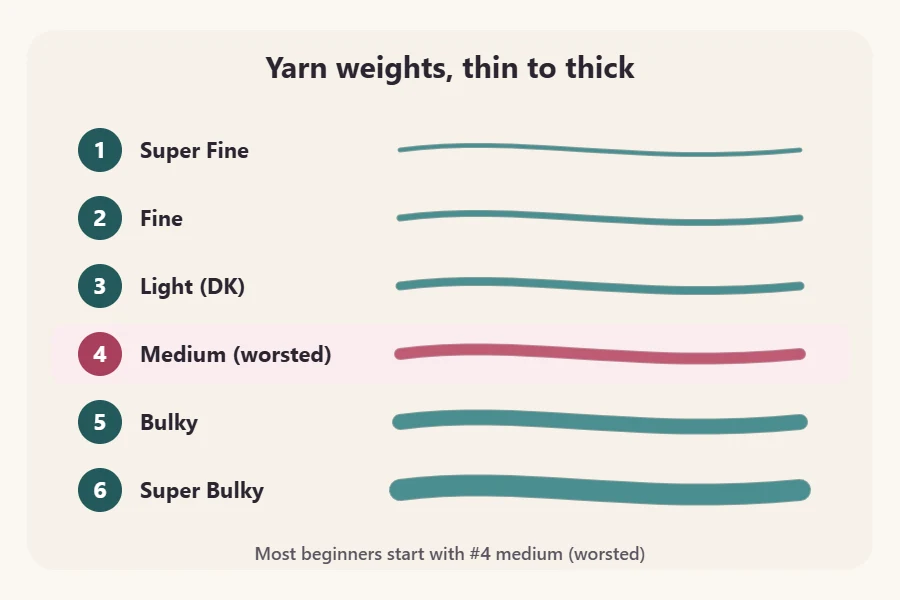
Worsted (#4) sits in the middle for good reason. The stitches are big enough to see and count, yet the fabric still grows at a satisfying pace. Thin yarns in categories 1 and 2 make small stitches that are hard to read and slow to build up. Super bulky yarn works up quickly, but the thick needles can feel awkward in new hands.
Fiber: wool, acrylic or cotton
Wool and wool blends
Wool has natural stretch. It springs back when pulled, which makes stitches easier to work and helps small differences in stitch size even out. A blend of wool and acrylic keeps much of that bounce and is often machine washable; check the care symbols on the label.
Acrylic
Acrylic is widely available, comes in many colors and is easy to care for. Pick one that feels soft and looks firmly twisted. Some acrylic yarns are splitty, meaning the needle tip pokes between the plies (the thinner strands twisted together to make the yarn) instead of going under the whole strand.
Cotton
Cotton has very little stretch, so it is less forgiving and shows uneven tension more than wool does. It is still the right fiber for kitchen and bath items because it absorbs water and washes well. Save it for the easy knit dishcloth pattern rather than your very first practice swatch.
Color: light and solid
You learn to knit by reading your stitches: telling one loop from the next, spotting a mistake, counting rows. Black, navy and deep brown hide all of that, especially under lamp light in the evening. Choose a light or medium shade such as cream, light gray, sky blue or soft green.
Stay with a solid color too. Variegated and self-striping yarns are fun later, but their color changes disguise the structure of the fabric while you are still learning to see it.
Yarns to avoid at first
- Fuzzy yarn, such as mohair or brushed blends. The haze hides the stitches and makes ripping out very difficult.
- Slippery yarn, such as silk, rayon or shiny ribbon. Stitches slide off the needle before you want them to.
- Novelty yarn with loops, bumps, eyelash strands or thick-and-thin sections. There is no clear stitch to read.
- Loosely twisted yarn. It splits easily and turns fluffy after being ripped out once or twice.
Tip
Look closely at the loose end of the strand before you buy. If it looks like a smooth, round cord, it will be easy to knit. If you cannot tell where the strand stops and the fluff begins, leave it for later.
One more thing to check is how the yarn is wound. A ball or a pull skein is ready to knit from. A hank, which is a large loop of yarn twisted into a braid shape, has to be wound into a ball first or it will tangle.
How to read a yarn label
The paper band around the yarn tells you nearly everything you need.
- Fiber content: what the yarn is made of, in percentages.
- Weight: a number from the chart above, often with a word such as “medium” or “worsted.”
- Yardage: the length of yarn in the ball, in yards and meters. Patterns ask for yards, so this is the number to match.
- Recommended needle size: a starting point, not a rule.
- Gauge: how many stitches and rows fit in 4 inches (10 cm) with that needle. Worsted yarn usually lists 16 to 20 stitches.
- Dye lot: the batch the yarn was dyed in. Shades vary slightly between batches, so buy all the yarn for one project from the same lot.
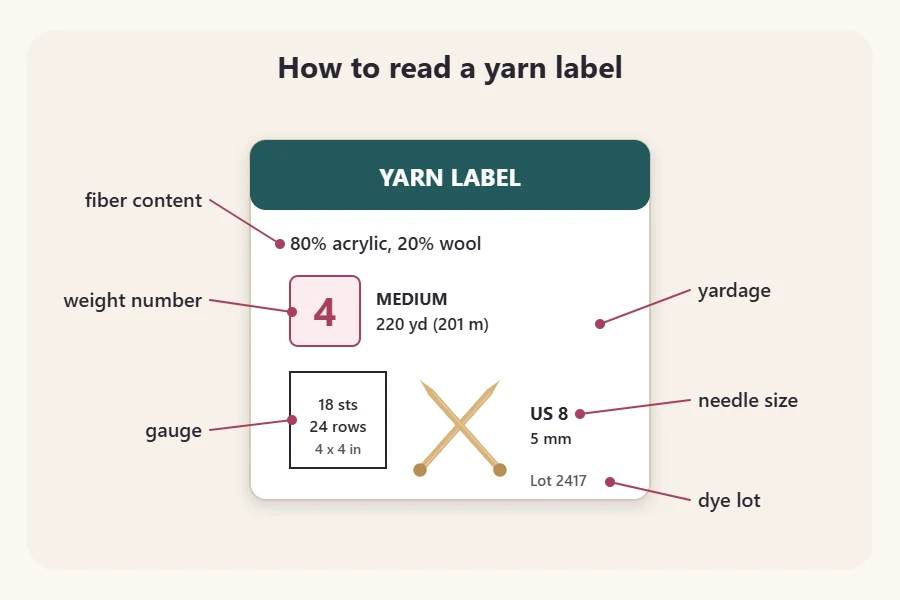
The gauge line matters more once you knit things that have to fit. When you reach that point, the guide to knitting and measuring a gauge swatch shows how to check it.
How much yarn to buy
For practice swatches, one ball of worsted yarn is plenty. For a project, go by yardage rather than the number of balls, since balls come in many sizes.
The easy garter stitch scarf on this site takes about 200 to 220 yards of worsted yarn, and the dishcloth takes about 60 yards of worsted-weight cotton. Buy everything at once, and if the total lands close to the limit, add one extra ball from the same dye lot.
Frequently asked questions
What weight of yarn is easiest for a beginner?
Medium-weight yarn, labeled worsted or number 4, is the easiest to learn with. Its stitches are large enough to see and count, it pairs with comfortable US 8 (5 mm) needles, and the fabric grows quickly enough to keep you going. Bulky yarn, number 5, is a good second choice.
Is acrylic or wool better for learning to knit?
Both work. Wool and wool blends have natural stretch, which makes stitches easier to work and hides small unevenness. Acrylic is easy to find and simple to wash. Whichever you pick, the strand should be smooth, firmly twisted and light in color, which matters more than the fiber itself.
Why is dark yarn hard for beginners?
Learning to knit depends on seeing your stitches, so you can tell loops apart, count rows and find mistakes. Black, navy and other deep shades absorb light and blur the outline of each stitch, especially indoors in the evening. A cream, light gray or pastel yarn shows the structure clearly.

